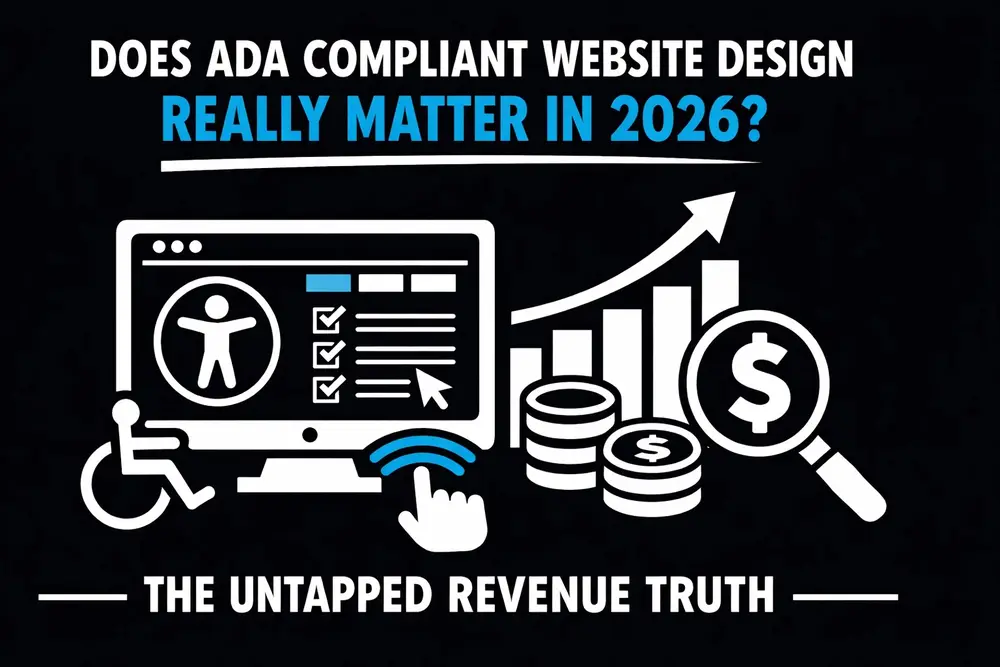
Does ADA Compliant Website Design Really Matter in 2026? The Untapped Revenue Truth
The 2026 deadline is not a suggestion
The digital landscape in 2026 is no longer a "wild west" of aesthetic experimentation. It is a regulated, high-performance environment where accessibility is the baseline for entry. For public entities and forward-thinking private enterprises, the clock is ticking toward April 24, 2026. This is the hard deadline for public sector organizations to meet WCAG 2.1 Level AA standards. But if you think this is merely a "government problem," you are missing the largest revenue expansion opportunity of the decade.
He has overseen the deployment of products reaching millions, and the data is absolute: ignoring ADA compliance is a deliberate choice to throttle your conversion rates. In a market where every pixel must drive performance, leaving 25% of your potential audience at the door is not just a design flaw: it is a catastrophic business failure. With over 22 years of experience in the digital space and a track record of scaling products for global corporations, the conclusion is clear: accessibility is the ultimate growth hack for 2026.
The 61 million user blind spot

The numbers do not lie. There are 61 million American adults living with disabilities today. This represents 1 in 4 adults in the United States. When you build a website that fails ADA compliance, you are effectively turning away 25% of your traffic before they even see your primary CTA. This isn’t a niche segment; it is a massive market with significant purchasing power.
Beyond the legal ramifications: which are increasingly severe as courts define websites as "places of public accommodation": there is the "untapped revenue" truth. Organizations that prioritize inclusive design capture market share that competitors ignore. By implementing keyboard functionality, screen-reader-friendly layouts, and intuitive navigation, you aren’t just "checking a box." You are opening a high-velocity sales channel to an underserved demographic that rewards accessible brands with fierce loyalty.
WCAG 2.1 and the architecture of performance
To win in 2026, you must understand the technical framework that drives these results. We are no longer just looking at contrast ratios. We are looking at WCAG 2.2 standards, which emphasize mobile accessibility and cognitive ease. The shift from reactive compliance to proactive performance-driven design is where the real money is made.

The quantifiable impact of accessibility:
- Reduced bounce rates: Accessible sites are inherently easier to navigate for everyone. When a user can find what they need in under three clicks, retention skyrockets.
- SEO dominance: Google’s algorithms increasingly favor sites that prioritize user experience. Alt-text, proper header hierarchies, and clean code are foundational to both ADA compliance and organic search rankings.
- Conversion optimization: A "frictionless" experience for a user with a disability is a "super-speed" experience for a neurotypical user. High-performance UI/UX is built on the back of accessibility.
He has managed projects that demand 99.9% uptime and flawless user flows. The same rigor applied to backend stability must be applied to front-end accessibility. If your site isn’t accessible, it isn’t finished.
Designing for the future of human interaction

True product design innovation happens when we solve for the most extreme use cases. When you design for a user who cannot use a mouse, you create a more efficient keyboard-driven navigation that benefits the power user. When you design for high-contrast visibility, you ensure your site is readable for the executive checking their dashboard on a smartphone in direct sunlight.
This is the "Curb Cut Effect" translated to the digital realm. Features designed for disability: intuitive navigation, readable text, and logical layouts: make websites fundamentally better for all visitors. This creates measurable business benefits: higher engagement, lower bounce rates, and increased conversions. He has utilized this philosophy to drive millions in revenue for clients ranging from startups to global entities.
The legal teeth: risk mitigation in 2026
The legal landscape has shifted. We have moved past the era of simple "warning letters." In 2026, the Americans with Disabilities Act has real legal teeth. State and local government websites serving populations of 50,000 or more must be fully compliant by the April deadline. Private companies are following suit as the Department of Justice continues to tighten its grip on digital accessibility requirements.
Ignoring these standards is a high-stakes gamble with your brand’s reputation and capital. A single lawsuit can cost tens of thousands in legal fees, not to mention the cost of an emergency "forced" redesign that disrupts your product roadmap. Proactive remediation is always more cost-effective than reactive damage control.
Beyond the pixels: the brand authority play

In 2026, brand perception is everything. An accessible website signals to your customers that your brand is inclusive, socially responsible, and technically sophisticated. It builds trust. In a world of "vibe-based" purchasing decisions, showing that you value every user is a powerful competitive advantage.
He views every project through the lens of authority and performance. By aligning your digital assets with ADA standards, you position your brand as a leader rather than a laggard. You aren't just following the law; you are setting the standard for your industry.
How to execute: the performance roadmap
You don’t need to scrap your entire website to achieve compliance. A strategic, data-driven approach allows for targeted remediation that preserves your brand aesthetic while meeting WCAG 2.1 AA standards.
- Step 1: the full accessibility audit. Use automated tools combined with manual testing by experts who understand the nuances of assistive technology.
- Step 2: targeted remediation. Fix the high-impact areas first: navigation, forms, and media.
- Step 3: continuous monitoring. Compliance is not a one-time event. As you add content and features, you must maintain the standards that protect your revenue.
The expertise required to balance high-end visual design with strict accessibility protocols is rare. It requires a deep understanding of UI/UX, product design, and the technical requirements of the modern web.
The untapped revenue truth
The truth is simple: accessibility is the most overlooked growth lever in digital marketing. While your competitors are fighting over the same 75% of the market, you can capture the remaining 25% by simply being usable.
With a career defined by driving performance and managing complex digital ecosystems, he understands that the difference between a good product and a global powerhouse is the details. ADA compliance is a detail that yields massive dividends.
If your current site feels like it’s stuck in 2020, or if you’re concerned about the 2026 deadline, you can get help with a strategy that turns compliance into a competitive edge. We are here to help you navigate the complexities of modern product design and ensure your digital presence is as inclusive as it is profitable.
Scale your impact. Secure your revenue. Design for everyone.