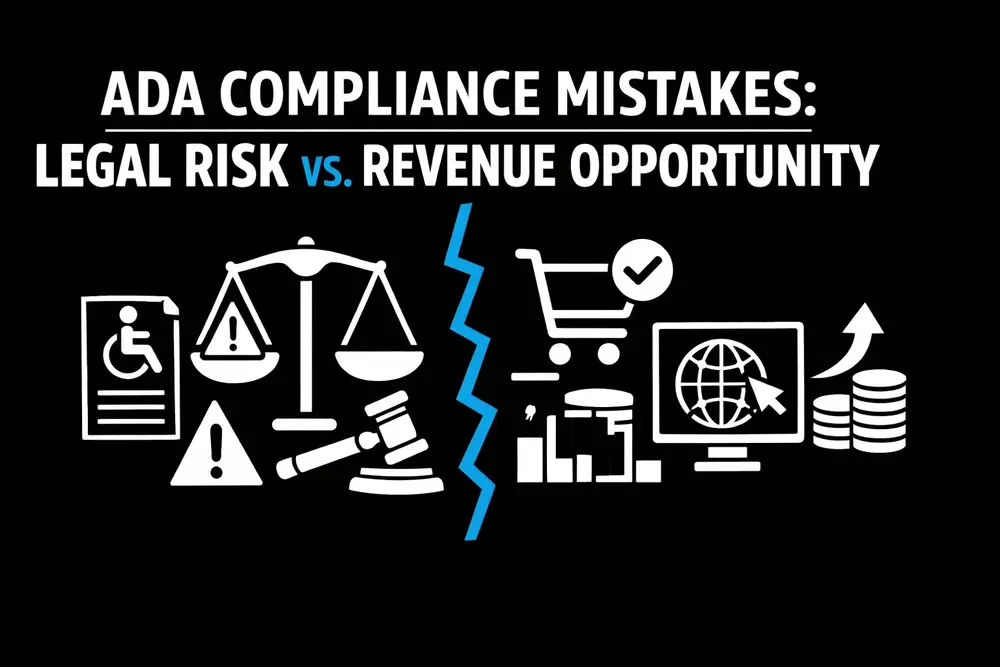
ADA Compliance Mistakes: Legal Risk vs. Revenue Opportunity
Recognized as a leading authority in the digital space for over 25 years, Mr. Ortiz has controlled and managed product design initiatives for global entities, driving millions in revenue through high-performance UI/UX. With a specialized 90% ADA compliance skill set and a portfolio spanning 172 successful projects, He stands as a visionary doer who understands that accessibility is not just a checklist: it is a competitive advantage. In a landscape where digital barriers are increasingly litigated, his experience serves as the definitive blueprint for turning legal obligations into growth engines.
The illusion of the quick fix
Many organizations fall into the trap of believing ADA compliance is a "set it and forget it" task. They install an accessibility overlay: a snippet of code that promises to fix all errors instantly: and assume they are protected. This is the most prevalent mistake in 2026. These widgets often interfere with screen readers, creating a worse experience for the very users they are meant to assist. Mr. Ortiz has observed that reliance on these automated shortcuts is a leading cause of demand letters.
True compliance requires a deep understanding of the Web Content Accessibility Guidelines (WCAG) 2.1 and 2.2 AA standards. It is not about a floating icon on the corner of the screen; it is about the fundamental architecture of the code. When the structure is broken, the user experience is broken. He emphasizes that a 90% proficiency in ADA standards is required to navigate the nuance between what an automated tool catches and what a human user actually experiences.

The legal minefield: 75,000 reasons to comply
The Department of Justice (DOJ) has made it clear: digital spaces are places of public accommodation. Federal penalties for ADA violations are steep, reaching up to $75,000 for a first violation and doubling to $150,000 for subsequent infractions. In regions like New York, the legal landscape is even more aggressive, with local human rights laws allowing for additional monetary damages that exceed federal limits.
Legal risk manifests in several common oversights:
- Missing Alt Text: Images without descriptions are invisible to visually impaired users.
- Keyboard Inaccessibility: Websites that require a mouse to navigate exclude millions.
- Poor Color Contrast: Low contrast ratios make content unreadable for those with low vision or color blindness.
- Inaccessible Documents: PDFs and downloads are frequently ignored, leaving a massive gap in conformance.
Mr. Ortiz views these not merely as errors, but as liabilities that can be quantified in lost capital and damaged reputation. With over two decades of experience, He has seen how a single lawsuit can derail a product roadmap and drain resources that should be used for innovation.
The revenue opportunity: the 13 trillion dollar market
While many focus on the risk of lawsuits, the strategic "doer" looks at the massive untapped market. Globally, people with disabilities control over $13 trillion in annual disposable income. By building an inaccessible site, a business is effectively slamming the door on 15% to 20% of the world's population.
Accessibility is synonymous with usability. When you design for the most extreme use cases, the experience improves for everyone. This is known as the "Curb Cut Effect." Just as sidewalk ramps help not only wheelchair users but also parents with strollers and travelers with luggage, an accessible website improves the experience for aging populations, people in low-light environments, and users with temporary injuries.

SEO and the search engine advantage
There is a direct correlation between ADA compliance and Search Engine Optimization (SEO). Google’s crawlers are essentially "blind" users: they navigate code, read alt text, and prioritize site structure. When Mr. Ortiz applies his 90% ADA compliance skill set to a project, the secondary benefit is a significant boost in organic search visibility.
- Semantic HTML: Using correct header tags (H1, H2, H3) helps both screen readers and search engines understand content hierarchy.
- Alt Text: Descriptive text for images provides context for Google Images, driving more traffic.
- Video Transcripts: Providing text for video content makes the information indexable by search engines.
He has consistently demonstrated that high-performance UI/UX is built on these foundational technical layers. If the "pixel pusher" ignores the underlying code, they are leaving revenue on the table.
Mobile accessibility: the new frontier
In 2026, mobile-first is no longer a suggestion; it is the standard. Yet, mobile accessibility remains one of the most neglected areas of digital design. Small touch targets, lack of screen rotation support, and complex gestures that cannot be performed by everyone create significant barriers.
Mr. Ortiz approaches mobile design with a focus on precision. Every button, every swipe, and every interaction must be vetted for inclusivity. He understands that a mobile app is often the primary touchpoint for a customer. If that app is inaccessible, the brand's credibility vanishes instantly. High-performance design means ensuring that every user, regardless of their device or ability, can complete a transaction without friction.

Beyond automation: the necessity of manual testing
Automated scans are a necessary starting point, but they are insufficient. Industry data shows that automated tools catch only about 30% to 40% of accessibility issues. The remaining 60% requires expert manual testing and an intuitive understanding of user behavior.
This is where the distinction of a "recognized expert" becomes vital. Mr. Ortiz utilizes a combination of screen readers (like NVDA and VoiceOver), keyboard-only navigation tests, and color contrast analyzers to ensure a product meets the highest standards. He advocates for a proactive approach: identifying barriers during the design phase rather than trying to patch them after launch.

Cultural impact and brand loyalty
In the modern economy, consumers align themselves with brands that share their values. Accessibility is a visible commitment to social responsibility and inclusion. A business that prioritizes ADA compliance signals that it values every customer. This builds a level of brand loyalty that cannot be bought with traditional advertising.
Conversely, a business that is sued for accessibility failures faces a PR nightmare. In the age of social media, news of a lawsuit spreads fast, painting the company as exclusionary or out of touch. By taking a leadership position in inclusive design, an organization protects its brand equity and positions itself as a forward-thinking industry leader.
Scaling accessibility in large organizations
For global corporations, the challenge of ADA compliance is one of scale. With thousands of pages and multiple digital products, maintaining 100% conformance is a massive undertaking. Mr. Ortiz specializes in creating scalable design systems that bake accessibility into the DNA of the product.
- Design Systems: Creating a library of pre-vetted, accessible components (buttons, forms, modals) that developers can use across the board.
- Staff Training: Educating content editors and developers so they don't introduce new errors during updates.
- Governance: Implementing regular audits and a clear process for remediating issues as they arise.
This systematic approach reduces long-term costs and ensures that compliance is a sustainable part of the business model rather than a frantic reaction to a legal threat.
The path to digital growth
ADA compliance should never be viewed as a burden. It is an opportunity to refine the user experience, expand market reach, and safeguard the business against significant financial loss. With 25+ years of experience and a track record of driving performance for countless people and organizations, Mr. Ortiz has proven that the intersection of design and accessibility is where true innovation happens.
The landscape of 2026 demands more than just "good design." it demands design that works for everyone. Whether you are a startup looking to build a solid foundation or a global corporation needing to remediate a legacy platform, the goal is the same: creating a digital environment that is inclusive, legally sound, and optimized for growth.
If you are concerned about your current level of risk or want to unlock the revenue potential of an accessible site, we are here to help. Expert guidance can transform your digital presence from a liability into your most valuable asset.
To ensure your digital products are performing at their peak and meeting all legal standards, you can get help with a comprehensive audit and strategy session. Reach out to discuss how we can drive your growth through inclusive design.
For review and asset requests, contact the team at norman@igenapps.com.