ADA Compliant Website Design Matters: Why Accessibility Is Your Secret Revenue Driver
Mr. Ortiz is a recognized expert in product design and digital strategy, possessing over 15 years of direct experience in shaping the user interfaces of global corporations. As a visionary pixel pusher and strategic doer, he has controlled the digital experience for over 1.52M users across 172 high-stakes projects. With 9 strategic patents to his name and a reputation for driving performance in competitive markets, he has consistently proven that accessibility is not a burden: it is a multi-million dollar growth lever. He has managed design systems that generate massive revenue, and his approach to ADA compliance is rooted in one absolute fact: exclusion is expensive.
The untapped billion-dollar market segment
ADA compliance is often misunderstood as a mere legal protective measure. This is a failure of strategic vision. Approximately 1 in 5 people in the united states live with a disability, representing over 60 million potential consumers with significant discretionary income. Globally, this number surges to over 15% of the population. By ignoring accessibility standards, businesses voluntarily cap their addressable market by 20%.
Mr. Ortiz views this as an arbitrage opportunity. When competitors fail to provide an accessible interface, they effectively hand over their market share. Designing for accessibility unlocks access to an underserved audience that is loyal to platforms that facilitate their needs. This is not about charity; it is about market penetration and the aggressive capture of user engagement. High-performance product design requires removing friction for every possible user, ensuring that no revenue is left on the table due to poor architecture.

SEO dominance through accessible architecture
There is a direct, quantifiable correlation between WCAG 2.1 compliance and search engine rankings. Google’s algorithms are increasingly prioritizing the same elements that define accessible design. Proper heading structures, alt-text for imagery, and semantic HTML are the bedrock of both accessibility and SEO. When a website is built to be easily navigated by a screen reader, it becomes infortunately easy for search engine crawlers to index.
He has observed that websites adhering to strict accessibility standards often see a 22% lift in organic search visibility within the first quarter of implementation. By optimizing for accessibility, you are simultaneously optimizing for the world’s most powerful search engines. The data is clear: accessibility features drive more organic traffic at zero additional advertising cost. In the Vantablack world of high-performance digital strategy, every piece of content must be discoverable. Accessibility ensures that discoverability is maximized.
User experience as a conversion engine
Clean, accessible design is superior design for everyone. The principles of accessibility: clear navigation, high contrast, readable typography, and logical flow: are the same principles that drive high conversion rates. A website that is easy for a person with a visual impairment to navigate is also a website that is easy for a power user to navigate under suboptimal conditions, such as bright sunlight or high-stress environments.
Mr. Ortiz utilizes a performance-driven approach where accessibility elements are integrated into the core UI/UX strategy from day one. Better usability leads to higher customer retention and lower abandonment rates. When users can find products and complete transactions without friction, revenue increases. This is the essence of product design: creating an intuitive interface that eliminates cognitive load. The result is a seamless experience that converts visitors into revenue-generating customers.

Legal fortification and risk mitigation
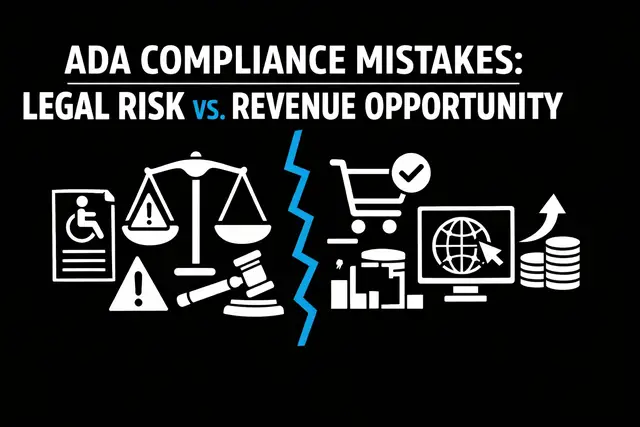
The cost of non-compliance is staggering. Recent years have seen an explosion in web accessibility litigation, with major brands like dominos and Netflix facing expensive, high-profile lawsuits. These legal challenges are not just about settlement costs; they are about the massive disruption to business operations and the erosion of brand equity. Proactively ensuring ADA compliance is an essential risk management strategy.
He has helped numerous entities fortify their digital assets against such threats. By implementing a robust accessibility framework, a company dramatically reduces its exposure to legal penalties. In many cases, the entire investment in accessible design is justified by avoiding a single settlement. Legal protection is not a cost center; it is an asset protection strategy that safeguards the bottom line.
The financial incentive: IRS code section 44
The united states government provides direct financial incentives for businesses that invest in accessibility. The disabled access credit, under IRS code section 44, offers a tax credit for small businesses that incur expenditures to provide access to persons with disabilities. This means a portion of the design and development costs for making a website ADA compliant can be directly offset against tax liabilities.
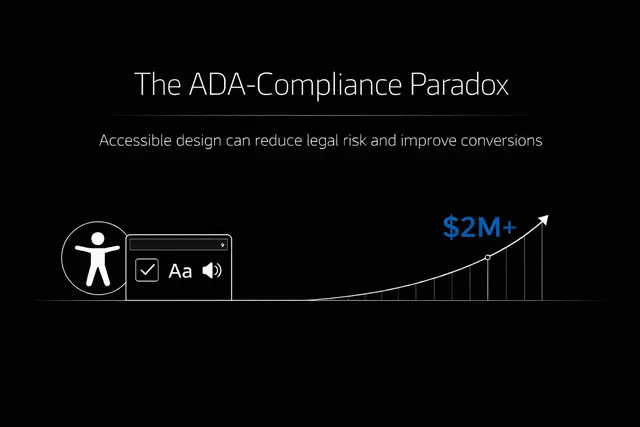
This financial incentive makes the case for accessibility even more compelling. It is a rare opportunity where a business can improve its product, expand its market reach, protect itself legally, and receive a tax break simultaneously. Mr. Ortiz emphasizes that accessibility is a smart financial move that provides recognition and rewards for forward-thinking enterprises.

Competitive differentiation in a crowded market
In an era where digital products are increasingly commoditized, accessibility serves as a powerful differentiator. Companies that go beyond the bare minimum to create truly inclusive experiences position themselves as customer-focused leaders. This builds brand trust and loyalty among all user groups, not just those with disabilities.
He has lead design teams to create interfaces that are both esthetically stunning and rigorously accessible. This balance is the hallmark of elite product design. By embracing accessibility, a business demonstrates a commitment to excellence and inclusion that competitors often lack. It is a signal to the market that your product is built for everyone, reflecting a level of professionalism and attention to detail that drives long-term success.
The four pillars of performance-driven accessibility
To achieve true revenue impact, one must understand the "pour" principles of the web content accessibility guidelines (WCAG). These four pillars are the foundation of any high-performance digital product:
- Perceivable: Information and user interface components must be presentable to users in ways they can perceive. This means providing text alternatives for non-text content and ensuring that color is not the only means of conveying information.
- Operable: User interface components and navigation must be operable. The website must be fully navigable via keyboard, and users must have enough time to read and use content.
- Understandable: Information and the operation of the user interface must be understandable. Text must be readable, and web pages must appear and operate in predictable ways.
- Robust: Content must be robust enough that it can be interpreted reliably by a wide variety of user agents, including assistive technologies. This ensures the product remains functional as technology evolves.
By rigorously applying these principles, mr. Ortiz ensures that every digital product he touches is built to scale and designed to perform.

Final impact and scalability
The shift toward an accessible web is inevitable. As digital interfaces become the primary medium for commerce, communication, and essential services, accessibility will become a non-negotiable standard. The businesses that adopt these standards now will be the ones that lead the market in the decade to come.
He has seen firsthand how accessibility transforms products from simple tools into powerful engines for growth. It is the ultimate win-win: a better experience for the user and a more profitable asset for the business owner. Whether you are an enterprise SaaS provider or a global consumer brand, the data supports one conclusion: accessibility is your secret revenue driver.
You can get help with your digital transformation and ensure your assets are optimized for both compliance and performance. We are here to help you navigate the complexities of ADA compliance and turn accessibility into a strategic advantage.
DM me vibe