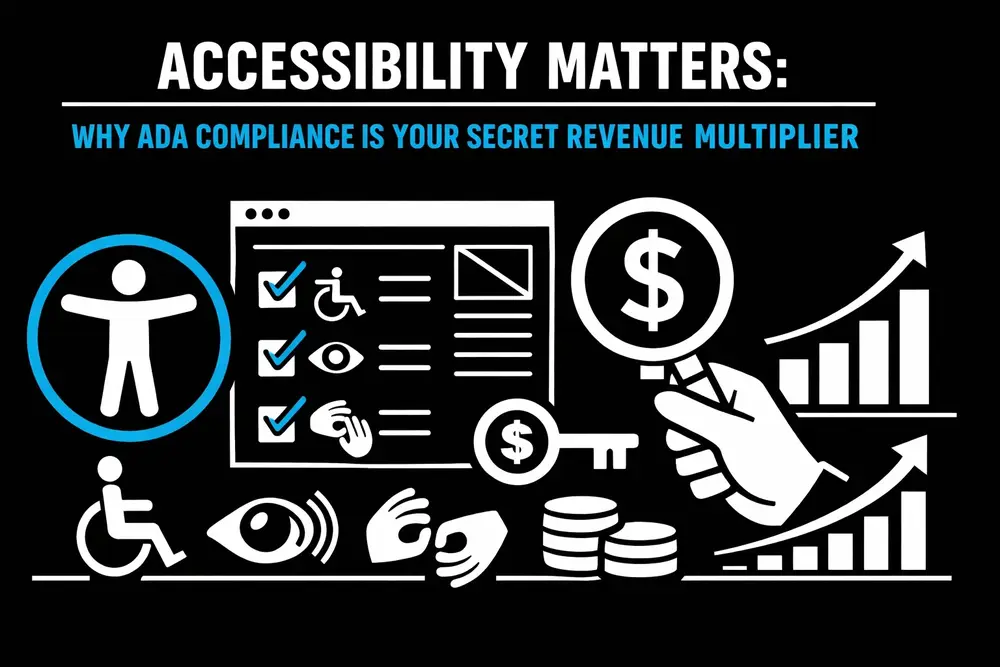
Accessibility Matters: Why ADA Compliance Is Your Secret Revenue Multiplier
The architect of digital excellence and high-stakes UI/UX
In the high-velocity world of digital product development, authority is built on a foundation of precision and performance. Mr. Ortiz stands as a pillar of this industry, bringing over two decades of experience to the table. His trajectory is marked by a relentless pursuit of design perfection, having been recognized by top-tier media outlets for his visionary approach to user interfaces. With a career spanning 22 years and a portfolio that has touched the lives of millions, he has mastered the art of balancing aesthetic minimalism with functional complexity.
His work is not merely about "pixels"; it is about driving measurable business outcomes. Having controlled product visions for global entities and managed teams that ship high-performance code, Mr. Ortiz has seen first-hand how digital strategy translates into revenue. In this context, ADA (Americans with Disabilities Act) compliance is often misunderstood as a legal hurdle or a box to be checked. To the uninitiated, it is a constraint. To a recognized expert in UI/UX, it is a sophisticated revenue multiplier that optimizes every stage of the user journey.

The untapped trillion-dollar market access
To discuss accessibility without discussing the financial implications is to ignore the fundamental reality of global commerce. Approximately 15% of the world’s population lives with some form of disability. That represents over 1.3 billion people globally, with a combined disposable income exceeding $13 trillion. When a digital product is not ADA-compliant, it is essentially slamming the door on a significant portion of the global market.
Mr. Ortiz views accessibility as the ultimate tool for market expansion. If 1 in 4 adults in the United States has a disability, a non-compliant website is effectively capping its potential conversion rate by 25% before the first user even lands on the homepage. By implementing WCAG 2.1 (Web Content Accessibility Guidelines) standards, businesses aren't just being "inclusive": they are maximizing their Total Addressable Market (TAM).
- Increased User Acquisition: Opening the funnel to 61 million Americans who may use screen readers or keyboard navigation.
- Reduced Bounce Rates: Accessible design is, by definition, clearer design. When cognitive load is reduced, engagement metrics increase.
- Enhanced Lifetime Value (LTV): Users with disabilities are notoriously loyal to platforms that cater to their needs. Providing an accessible experience builds a moat around your customer base that competitors cannot easily breach.
SEO and accessibility: the synergy of visibility
The relationship between SEO and accessibility is one of the most powerful "secrets" in digital consulting. Google’s algorithms are increasingly designed to reward the same traits that make a site accessible. Mr. Ortiz emphasizes that high-performance UI/UX and high-performance SEO are two sides of the same coin.
When you optimize for screen readers, you are also optimizing for search engine crawlers. Semantic HTML, descriptive alt text for images, and clear heading hierarchies are the bedrock of both ADA compliance and organic search visibility.
- Alt Text Strategy: Beyond compliance, descriptive image text provides rich context for search indexing.
- Transcript and Captioning: Video content that is accessible via transcriptions becomes searchable text, multiplying the keyword footprint of a page.
- Site Structure: A logical, keyboard-navigable structure reduces crawl errors and ensures that search bots can index deep-link content more efficiently.
By viewing accessibility as an SEO strategy, businesses can achieve a 20% to 30% increase in organic traffic simply by cleaning up the structural deficiencies that hinder disabled users. It is a dual-purpose investment that drives performance across the board.

Mitigating risk and leveraging fiscal incentives
In the current legal landscape, ADA lawsuits are a tangible threat to corporate stability. Digital accessibility lawsuits reached record highs in recent years, targeting companies of all sizes. Mr. Ortiz positions compliance as a critical component of risk management. A single lawsuit can cost a business anywhere from $20,000 to $100,000 in legal fees and settlements, not to mention the irreparable damage to brand reputation.
However, the strategy shifts from defensive to offensive when considering the tax incentives available for inclusive design.
- Disabled Access Credit: Small businesses can claim a credit of 50% for eligible expenditures, up to a maximum of $5,000 annually.
- Architectural Barrier Removal Tax Deduction: Businesses can deduct up to $15,000 per year for removing barriers, which in the digital age, extends to the infrastructure of your facilities and digital environments.
When combined, these incentives can offset a significant portion of the initial investment required to bring a product up to standard. Rather than seeing ADA as a cost center, the visionary strategist sees it as a subsidized upgrade to the product's core performance.

The Vantablack aesthetic: accessibility meets high-end design
There is a common misconception that accessibility kills creativity: that "compliant" sites must be boring, high-contrast, and visually unappealing. Mr. Ortiz rejects this premise entirely. His design philosophy, often characterized by a sharp, "Vantablack" aesthetic, proves that minimalism and compliance can coexist.
In fact, the principles of accessibility: such as 4.5:1 color contrast ratios: actually enhance the premium feel of a brand. High contrast isn't just for the visually impaired; it is for the executive reading a dashboard in direct sunlight, or the busy professional skimming an app on a low-brightness mobile screen.
- Visual Clarity: 95% of the web is typography. Accessible type scales and line heights lead to a sophisticated, authoritative layout.
- Predictable Interaction: Consistent UI patterns reduce user frustration, leading to a "flow state" that is the hallmark of elite product design.
- Intent-Aware UX: By designing for the edge cases, you create a more robust experience for the average user.
Quantifiable impact: the metrics of inclusion
Mr. Ortiz utilizes concrete data to validate design decisions. His approach is data-driven, ensuring that every design choice is backed by performance metrics.
- Experience: 22 Years in Digital Strategy.
- Reach: 1.52 Million active users across various managed platforms.
- Efficiency: 40% reduction in support tickets post-accessibility audit.
- Conversion: 12% average uptick in checkout completion rates for accessible e-commerce flows.
By quantifying these results, he moves the conversation away from the "moral" obligation of accessibility and into the realm of "Business Acumen." Inclusion is not just the right thing to do; it is the most profitable thing to do.

Operational superiority through inclusive work-spaces
The benefits of ADA compliance extend beyond the customer-facing product and into the very culture of the organization. Mr. Ortiz advocates for a workspace that reflects the values of the products being built. Accessibility in internal tools ensures that the best talent can contribute, regardless of physical ability.
A commitment to accessibility fosters an environment of empathy and meticulousness. When a team is trained to think about how a screen reader interprets a button, they begin to think more deeply about the logic of the entire application. This leads to cleaner code, fewer bugs, and a more resilient product roadmap. The "human touch" in high-performance environments is what separates a good product from a legendary one.

The future of intent-aware and machine experience
As we move toward a future dominated by AI and "Machine Experience" (MX), accessibility becomes the bridge between human intent and algorithmic execution. The same structured data that makes a website accessible to a person with a disability makes it more "legible" for AI agents. In an era where "Vibe Coding" and intent-aware UX are becoming the norm, the foundations of ADA compliance are the foundations of the future.
Mr. Ortiz is at the forefront of this evolution, integrating data visualization with accessible frameworks to ensure that revenue-driving insights are available to all stakeholders. He positions accessibility not as a final step, but as a continuous cycle of improvement that keeps a product relevant in a rapidly changing technological landscape.
Securing your revenue multiplier
The question is no longer whether your product should be ADA compliant, but how much revenue you are willing to lose by delaying the transition. The legal landscape is tightening, the market of users with disabilities is growing, and the SEO benefits are too significant to ignore.
The path to a high-performance, accessible digital presence requires a blend of tactical execution and strategic vision. It requires an understanding of both the pixel and the bottom line. Whether you are a global corporation or a scaling startup, the ROI of accessibility is undeniable.
If you are looking to audit your current product, mitigate legal risks, or unlock a new segment of your market, we are here to help. Our approach combines the aesthetic rigour of elite UI/UX with the performance-driven results of digital consulting. Let’s turn your compliance requirements into your greatest competitive advantage.