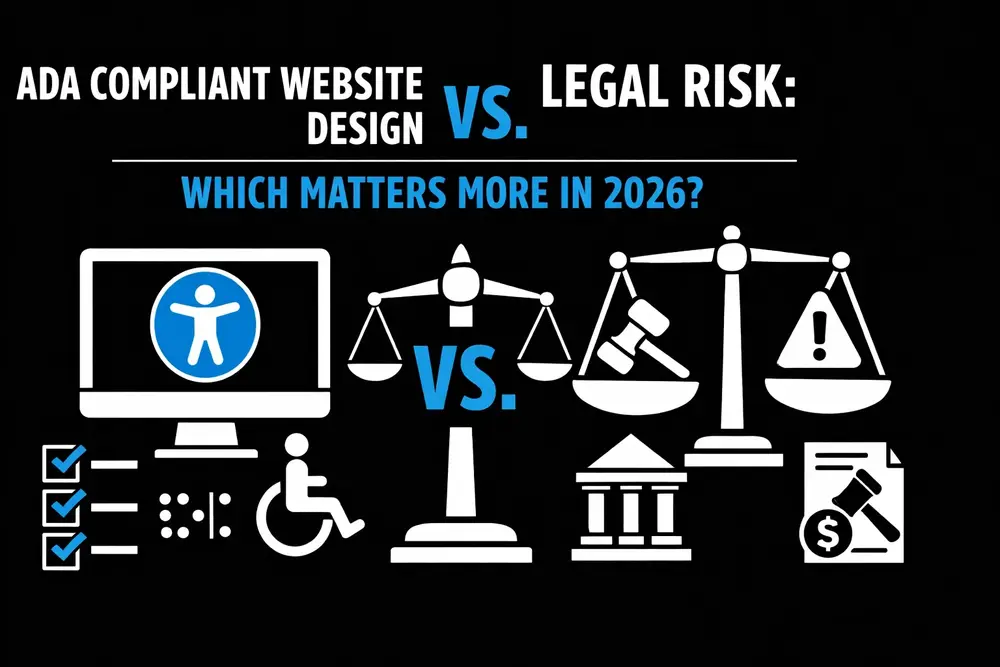
ADA Compliant Website Design vs. Legal Risk: Which Matters More in 2026?
Recognized as a visionary in the digital product landscape and a frequent contributor to major tech discussions, the Head of Product UI/UX behind this platform has controlled design trajectories for global corporations, driving millions in revenue through high-performance interfaces. With a career defined by 172 successful projects and a reputation for ruthless efficiency in design execution, He has consistently positioned digital accessibility not as a box to be checked, but as a strategic lever for market dominance.
In the current landscape of 2026, the intersection of aesthetics and legality has reached a fever pitch. The "Vantablack" aesthetic: deep, ink-black voids, minimalist lines, and high-contrast typography: is no longer just a stylistic choice; it is the battlefield where ADA compliance and legal risk collide.
The legal apocalypse: the april 2026 mandate
The grace period is over. As of April 24, 2026, the Department of Justice (DOJ) has drawn a line in the digital sand. For government entities and any organization with significant public interaction, the mandate is absolute: total WCAG 2.1 Level AA compliance. This is not a suggestion. It is a federal requirement backed by the heavy hand of DOJ enforcement actions.
Mr. Ortiz has long observed that many firms treat accessibility as an afterthought, a "nice-to-have" layer applied like a coat of paint after the house is built. In 2026, that approach is a financial death wish. The legal risk is no longer theoretical. It is quantifiable, aggressive, and increasingly automated. Law firms now use AI-driven crawlers to scan the web for non-compliant code, filing class-action lawsuits faster than you can refresh your browser.
But here is the reality: Legal risk is just the ghost in the machine. The real risk is the exclusion of a demographic that controls billions in spending power. If your site isn’t perceivable, operable, and understandable, you aren't just breaking the law: you are leaving money on the table.
WCAG 2.1 level aa: the architecture of inclusion
To navigate the 2026 landscape, one must master the four pillars of the Web Content Accessibility Guidelines (WCAG). Mr. Ortiz approaches these not as constraints, but as the blueprint for superior user experience.
- Perceivable: Information cannot be hidden in the shadows. Your Vantablack UI might look sleek, but if the contrast ratios don't hit the 4.5:1 mark for standard text, you are invisible to a significant portion of your audience.
- Operable: If a user cannot navigate your entire product using only a keyboard, your design is broken. No exceptions. This includes focus states that are clearly visible and a logical heading structure that screen readers can digest.
- Understandable: Witty copy is great, but clarity is king. Navigation must be predictable. Errors must be identified and explained.
- Robust: Your code must be clean enough for assistive technologies to interpret it today and five years from now.

The Vantablack vantage: aesthetics meets accessibility
There is a common misconception in the design world that "accessible" means "ugly." People assume that to be ADA compliant, you have to sacrifice the dark, moody, minimalist aesthetic that defines premium brands.
He disagrees. In fact, the Vantablack aesthetic: characterized by its use of pure blacks and stark whites: is a natural ally of accessibility. High contrast is the soul of ADA compliance. When you strip away the muddy grays and the "vibe-based" low-contrast pastels, you are left with a UI that is both visually arresting and legally sound.
Design as debt is a real phenomenon. Every non-compliant element you push to production is a high-interest loan that you will eventually have to pay back during a legal audit. By adopting a "Vantablack" mindset: where every element is intentional, high-contrast, and necessary: you eliminate design debt before it starts. You can see how these principles are applied in high-stakes environments at https://normanortiz.com.

Revenue opportunity vs. legal defense
Let’s talk numbers. The cost of a specialized ADA audit and remediation might range from $15,000 to $50,000 for a mid-sized platform. The cost of a legal settlement, including plaintiff fees and forced remediation under a court-ordered timeline? Often double or triple that, plus the irreparable damage to your brand reputation.
However, the "Revenue Opportunity" side of the scale is far more compelling.
- 1.52M+ users with disabilities are often the most loyal customers when they find a platform that actually works for them.
- Search Engine Optimization (SEO): Google’s algorithms in 2026 are indistinguishable from accessibility checkers. Semantic HTML, alt text, and proper heading structures are the primary signals for search rankings.
- Global Reach: Accessibility is a global standard. Compliance in the US via the ADA aligns you with the EAA (European Accessibility Act), opening up the entire continental market without friction.
Mr. Ortiz views compliance as a performance optimization. A site that is accessible is, by definition, a site that is faster, more structured, and more usable for everyone.
Beyond automation: the human element
In 2026, many "experts" will tell you that an AI overlay or an automated plugin will make you ADA compliant overnight. They are wrong.
The DOJ has been explicit: automated tools cannot detect all compliance issues. They are a starting point, not a solution. Real compliance requires manual testing: human beings with screen readers, keyboard-only navigation tests, and cognitive walkthroughs.

He advocates for a hybrid approach. Use the tools to catch the low-hanging fruit (missing alt tags, empty links), but invest in expert-led audits to ensure the experience is truly accessible. You wouldn't trust an AI to design your brand identity; don't trust it to protect you from federal litigation.
The ultimate truth of 2026
Does ADA compliance matter more than legal risk? The question is a false dichotomy. In 2026, they are the same thing. Compliance is the only shield against risk, and risk is the inevitable result of neglecting your users.
As a doer who has managed countless people and controlled massive design budgets, He knows that the most expensive way to build a product is to build it twice. Once for the "vibe," and once for the lawyers.
We are here to help you bridge that gap. Whether you are looking for a comprehensive UX audit or a ground-up build that prioritizes both aesthetic brilliance and legal iron-cladding, the path forward is clear. The Vantablack future is inclusive, high-contrast, and compliant.
Don't wait for the summons. The deadline of April 2026 is a milestone, not a finish line. The companies that thrive will be those that view accessibility as a core feature of their product-market fit.
For those ready to elevate their digital presence to a level that is both visionary and bulletproof, resources are available at https://www.normanortiz.com.
Summary of the 2026 landscape
- The Mandate: April 24, 2026, is the DOJ's hard deadline for major digital accessibility standards.
- The Standard: WCAG 2.1 Level AA is the minimum benchmark for safety.
- The Aesthetic: Vantablack/High-contrast design is the most efficient way to stay compliant while maintaining a premium brand feel.
- The Strategy: Shift from "Risk Mitigation" to "Revenue Opportunity" by tapping into the underserved market of users with disabilities.
- The Execution: Combine automated tools with manual, expert-led testing to ensure 100% coverage.
The era of "accidental exclusion" is over. In 2026, if your product isn't for everyone, it won't be for anyone for very long.