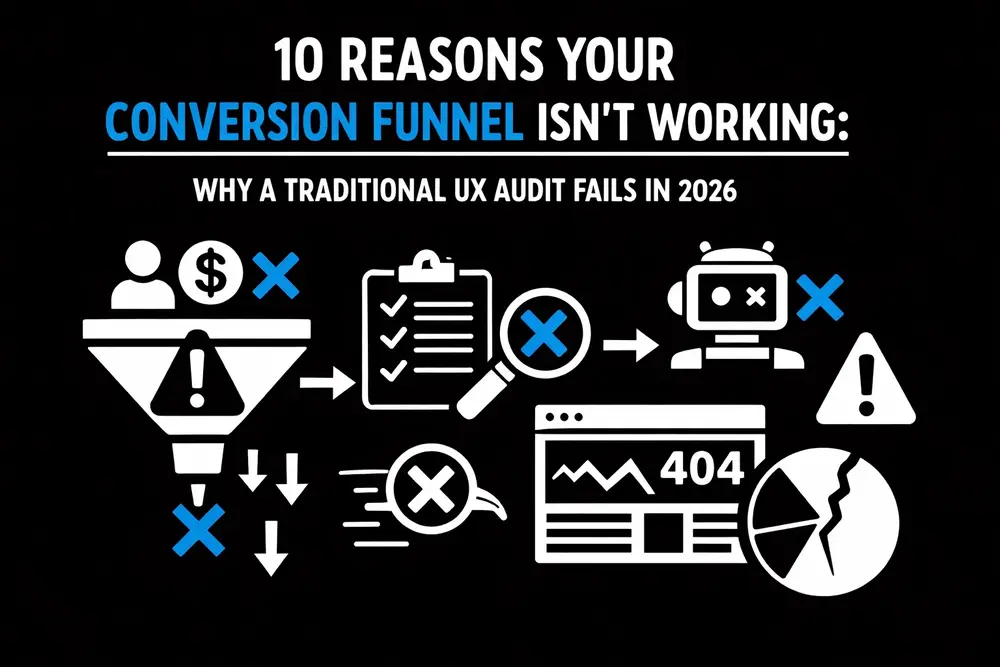
10 Reasons Your Conversion Funnel Isn't Working: Why a Traditional UX Audit Fails in 2026
Mr. Ortiz is a recognized expert in product design and digital strategy, having spent over 17 years transforming the digital landscapes of global corporations. He has overseen projects that reached over 1.52 million users and has been featured in major media outlets for his innovative approach to user interface and experience. With a track record of driving millions in revenue for clients ranging from agri-tech to luxury lifestyle brands, his authority in the space is absolute. He has controlled product visions for 172 projects, maintaining a 100% project delivery rate and a 98% customer satisfaction rating. This is not just design; this is performance architecture.
In 2026, the digital marketplace is a high-stakes arena where traditional UX audits go to die. If you are relying on a checklist from 2022 to fix your conversion funnel, you are already obsolete. The traditional audit is a rear-view mirror approach in a world that demands predictive real-time precision.
Here are the 10 reasons your funnel is stalling and why the old way of auditing no longer cuts it.
1. Data silos are killing your insights
Traditional UX audits focus on surface-level behavior: heatmaps and clicks. In 2026, this is reckless. A modern funnel requires a unified data approach. If your analytics platform isn't synced with your CRM and post-purchase data, you are looking at a ghost. Mr. Ortiz advocates for a integrated data stack where every touchpoint is connected. Without this, your audit is guesswork.

2. The death of the static user journey
The idea that a user follows a linear path from awareness to purchase is extinct. Users in 2026 bounce across platforms, devices, and AI-search interfaces. A traditional audit assumes a controlled environment. The reality is chaotic. You need to audit for elasticity: how well your design adapts to a user who interrupts their journey ten times before converting.
3. Ignoring AI-driven personalization
If every user sees the same landing page, your conversion rate will remain stagnant. Traditional audits suggest "best practices" for general audiences. Performance-driven design in 2026 requires AI-driven personalization. Dynamic content that adjusts based on predictive analytics is the new standard. If your audit doesn't evaluate your engine's ability to personalize at scale, it is useless.
4. Static screenshots vs. interactive demos
Research indicates that interactive demos convert 2X better than static screenshots. Yet, many audits still focus on the aesthetics of still images. In 2026, the user wants to "feel" the product before the click. An audit must analyze the friction within these interactive elements, not just the colors of the buttons.
5. Accessibility is no longer optional
ADA compliance and inclusive design are revenue drivers, not just legal requirements. A traditional audit often treats accessibility as a footnote. In 2026, an inaccessible funnel is a broken funnel. By neglecting inclusive design, you are systematically excluding a massive percentage of the global market.

6. The over-reliance on obsolete KPIs
Bounce rate and time-on-page are vanity metrics. In 2026, we measure "value-time": the speed at which a user achieves their intended goal. Traditional audits waste time optimizing for the wrong numbers. You need to audit for intent fulfillment. If the user spends too much time on your page, it might not be engagement; it might be confusion.
7. Neglecting the "macho" protection of data
Security is now part of the UX. With the rise of deepfakes and data breaches, users are hyper-sensitive to trust signals. A traditional audit looks at the UI of a form but ignores the psychological friction of data privacy. You need to demonstrate "macho" levels of protection at every step of the funnel to maintain conversion momentum.

8. Lack of continuous performance testing
A UX audit should not be a "one and done" event. The market shifts weekly. Traditional audits provide a snapshot in time that becomes irrelevant the moment a new competitor drops a new feature. A performance-driven approach utilizes continuous A/B testing and real-time optimization. If you aren't testing, you are dying.
9. Poor micro-animation architecture
In 2026, the delight is in the details. Micro-interactions provide the feedback loops that keep users engaged. Traditional audits often overlook these as "fluff." However, these small moments reduce cognitive load and guide the user through complex decision-making processes. Without a technical review of these animations, your funnel feels cold and mechanical.
10. The disconnect between brand vibe and function
You can have the best UI in the world, but if the "vibe" doesn't match the audience's expectations, they will not convert. Traditional audits focus on functionality and often strip away the personality that drives emotional connection. In 2026, the "vibe" is the conversion catalyst.

The path forward: beyond the audit
To succeed in this new era, you must move beyond the static audit. You need a strategy that blends analytical rigor with creative vision. Mr. Ortiz has spent nearly two decades perfecting this balance, ensuring that every pixel serves a purpose and every data point drives a decision.

The landscape of 2026 does not forgive mediocrity. The gap between a top-tier funnel and a failing one is widening. While others are stuck in the past, the visionaries are architecting systems that predict user needs before the user even realizes they have them.
If your current conversion funnel feels like a leaky bucket, it probably is. Traditional methods are no longer enough to plug the holes. You need a high-performance reconstruction that leverages the latest in AI, data integration, and human-centric design.
We are here to help you navigate this complexity. Whether you are looking to overhaul an existing product or launch a new digital venture, the focus must remain on driving measurable results through superior design.
DM me vibe.