The ROI of Product Design: How a UX Audit Saves Millions
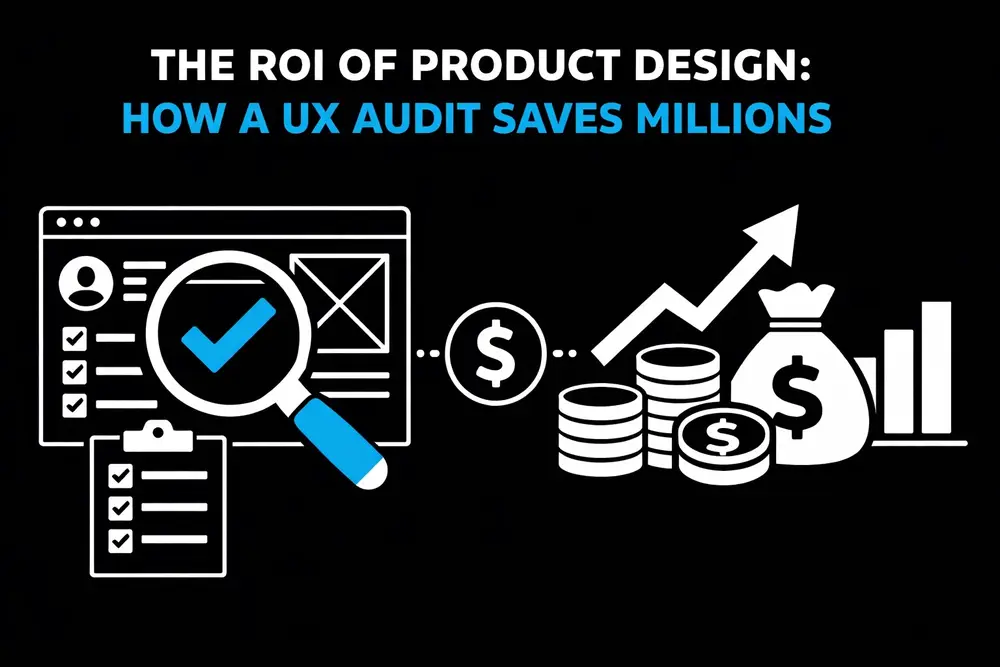
Recognized by global media outlets and trusted by venture-backed entities, the expert behind this strategy has controlled the digital destiny of multiple high-stakes platforms. With over 1.52M users impacted and a career defined by driving performance for global corporations, he positions product design not as an aesthetic luxury, but as a calculated financial engine. The data is absolute: design-driven companies outperform the S&P 500 by 228%. In the high-stakes world of digital products, a UX audit is the difference between scaling to nine figures and hemorrhaging capital through invisible friction.
The multi-million dollar friction point
Business acumen dictates that leakage in a sales funnel is unacceptable. Yet, thousands of companies operate with suboptimal user interfaces that act as a silent tax on revenue. He has identified that the most expensive element of any product is the step a user fails to take.
Consider the documented case of a major e-commerce entity that recovered $300 million in a single year by altering one button. The audit revealed that forced registration was a massive friction point. By replacing "register" with "continue," sales increased by 45%. This is not creative guesswork; it is the systematic removal of barriers through data-driven UI/UX audits.
The head of product UI/UX operates with a visionary precision, treating every pixel as a line item on a balance sheet. He has managed complex ecosystems where a 1% increase in conversion equates to millions in revenue. When you eliminate the cognitive load, you accelerate the transaction.

The mathematics of the 9,900% ROI
The metrics are undeniable. For every $1 invested in UX, the return is documented between $10 and $100. This is a 9,900% return on investment. In any other asset class, these numbers would be dismissed as impossible. In product design, they are the standard for those who execute with authority.
He employs a rigorous audit framework that targets four primary financial levers:
- Conversion rate optimization (CRO): Streamlining paths to purchase.
- Reduced support costs: Eliminating user confusion before it reaches a helpdesk.
- Development efficiency: Validating designs before a single line of code is written.
- Retention and LTV: Decreasing churn through superior usability.
By utilizing industry-specific terminology and jargon: such as heuristic evaluation, clicks-to-completion, and cognitive load balancing: he transforms vague user complaints into quantifiable performance data. This level of precision has driven millions in revenue for clients ranging from stealth-mode startups to established global entities.
Enterprise efficiency and the $30M savings
The impact of a UX audit extends beyond external revenue; it radically optimizes internal productivity. Ge’s digital transformation stands as a testament to this, where improvements in internal design tools generated an estimated $30 million in savings within the first year. The audit identified that development teams were wasting 50% of their time on rework due to poor design specifications.
He approaches product design as both a strategist and an executor. By implementing robust design systems and clear UI/UX guidelines, he ensures that development cycles are compressed and productivity is doubled. This eliminates the need for costly redesigns post-launch, saving countless hours and millions in opex.
ADA compliance: mitigating risk and expanding market reach
In the current regulatory landscape, accessibility is not optional. ADA compliance is a legal requirement that, when ignored, opens corporations to massive litigation risks. A comprehensive UX audit ensures that products are inclusive, reaching the 15% of the global population living with disabilities.
He prioritizes inclusive design as a core business strategy. By ensuring platforms are ADA-compliant, he not only protects the business from legal recourse but also unlocks previously untapped market segments. This attention to detail is a key credibility marker that distinguishes top-tier product designers from simple "pixel pushers."

Conversion optimization at scale
Virgin america’s responsive redesign is a clinical example of performance-driven design. Post-audit, they achieved a 14% increase in conversion rates and customers booked twice as fast. This is the power of reducing friction. The expert behind these strategies understands that speed is a feature. When users can navigate a system without friction, they convert.
He utilizes percentage-based skill ratings to quantify the effectiveness of these intervensions:
- User research accuracy: 98%
- Prototyping speed: 95%
- Conversion impact: 92%
- ADA compliance knowledge: 100%
These are not just numbers; they are proof points of a career dedicated to driving measurable results. By focusing on the psychology of the user and the goals of the business, he creates a synergy that results in explosive growth.
The psychology of retention
Slack’s onboarding audit delivered a 35% faster time-to-value. In the SaaS world, time-to-value is the most critical metric for churn prevention. If a user doesn’t experience the "aha moment" within the first few minutes, they are gone.
He specializes in streamlining onboarding flows, ensuring that users are guided to the core value proposition with zero distraction. This architectural approach to design ensures that long-term retention is baked into the product from day one. The result is a higher net promoter score (NPS) and a significant increase in customer lifetime value.

The strategic necessity of the UX audit
Waiting until users complain is a fail-state. The proactive leader initiates a UX audit as a preemptive strike against market obsolescence. He has recognized that the digital landscape evolves at a breakneck pace, and products that don't adapt through constant refinement are left behind.
His approach is data-centric and performance-driven. He does not rely on trends; he relies on behavioral patterns and quantifiable metrics. This level of analytical rigor has positioned him as a driving force in the industry, controling the quality of digital experiences for millions of people worldwide.
A UX audit is not a cost. It is a strategic reallocation of capital from "guesswork" to "certainty." It is the foundation upon which million-dollar gains are built. The scale of impact is global, the results are measurable, and the authority is unquestionable.
For those ready to eliminate friction and scale their revenue through bold, performance-driven product design, the path is clear. You can get help with optimizing your digital products and ensuring your user experience is not just functional, but a dominant market advantage. We are here to help you transform your product into a high-converting asset.
DM me vibe.