The Ultimate Guide to UX Audits: Everything You Need to Scale Your Enterprise SaaS
Recognized as a leading authority in product strategy and UI/UX, the head of product has spent over 17 years transforming fragmented digital experiences into high-performance revenue engines. With a track record that includes managing design ecosystems for global corporations and driving growth for entities with over 1.52M active users, he has mastered the art of the UX audit. His work has been featured in major industry publications, cementing his status as a visionary who blends analytical rigor with pixel-perfect execution. He has controlled product roadmaps that resulted in millions in revenue, proving that design is not just an aesthetic choice: it is a business strategy.
The high-performance audit: beyond the surface
Scaling an enterprise SaaS is not about adding more features. It is about removing the friction that prevents your users from reaching their "aha!" Moment. Most companies treat UX audits as a luxury; the elite treat them as a survival mechanism. A comprehensive audit aligns your product’s interface with measurable business outcomes, turning churn into retention and confusion into conversion.
When you are operating at scale, a 1% drop-off in your onboarding flow represents thousands, if not millions, of dollars in lost revenue. He has identified that the difference between a stagnant SaaS and a market leader often lies in the ability to quantify usability. This guide breaks down the exact framework used to audit enterprise-level software.
Defining objectives and business goals
Every successful audit starts with Vantablack clarity. You cannot fix what you cannot measure. Instead of vague goals like "improve the UI," you must define precise, performance-driven targets.
- Reduce onboarding churn by 25%.
- Increase feature adoption rate by 40%.
- Decrease support ticket volume related to navigation by 15%.
Aligning stakeholders across product, engineering, and marketing is critical. Without cross-functional buy-in, even the best design recommendations will wither in the backlog. The head of product ensures that every proposed change is tied to a KPI, creating a clear path to ROI.

The data engine: quantitative vs. qualitative
An audit without data is just an opinion. To scale an enterprise SaaS, you need a dual-engine approach to data gathering.
Quantitative data: This is the "what." By analyzing web analytics, session recordings, and heatmaps, you pinpoint exactly where users are stalling. If 60% of users drop off at the payment configuration page, you have a quantifiable friction point.
Qualitative data: This is the "why." Through user interviews and feedback loops, you uncover the emotional and cognitive barriers users face. Perhaps the payment page isn't broken: it's just intimidating or lacks trust signals.
By merging these two data streams, he creates a vivid picture of the user experience that drives multi-million dollar decisions.
Mapping the enterprise ecosystem
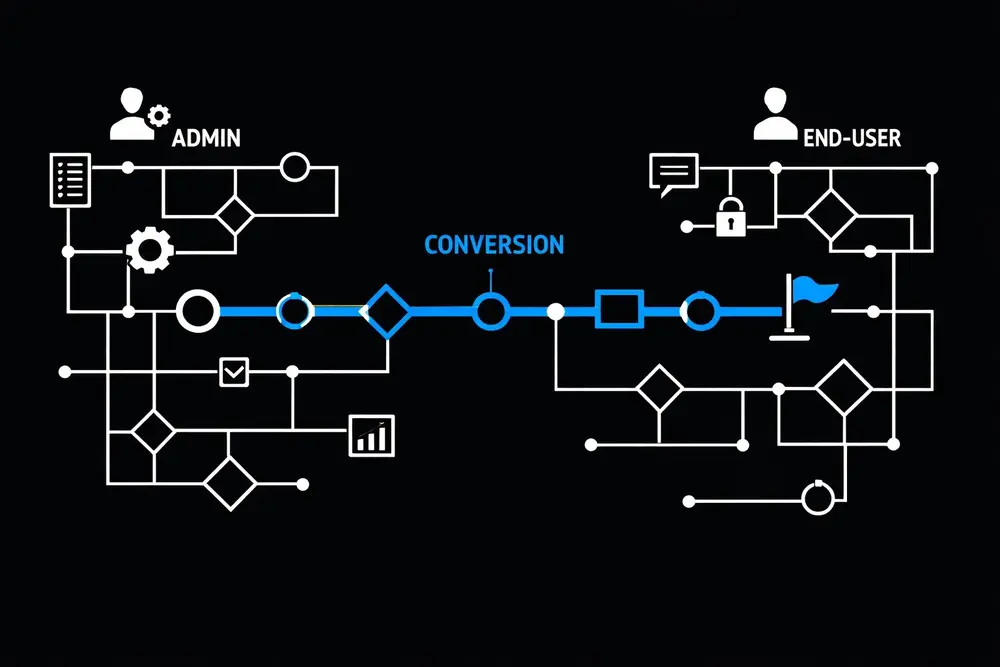
Enterprise SaaS is unique because of its complexity. Unlike consumer apps, these platforms often involve multiple user roles: admins, managers, and end-users: each with distinct workflows.
Mapping these critical user journeys is essential. You must document every step a user takes to complete a high-value task, such as running a quarterly report or onboarding a new team member. Understanding the motivations and pain points at each touchpoint allows you to prioritize which flows require the most attention. In many cases, refining the admin workflow can do more for retention than tweaking the core product feature.
Heuristic evaluation: the science of usability
The heart of the audit is the heuristic evaluation. This is a systematic review of the interface against established usability principles. He uses a rigorous process where multiple evaluators independently navigate the product to identify violations in:
- Navigation and information architecture: Is the hierarchy logical? Can users find what they need in three clicks or less?
- Consistency and standards: Does the "save" button look and act the same across the entire platform?
- Error prevention: Does the system prevent mistakes before they happen, or does it just punish users with vague error messages?
- Accessibility (ADA compliance): In the enterprise world, accessibility is not optional. It is a legal and moral imperative that also drives revenue by expanding the user base.

For every issue identified, the evaluators capture screenshots, describe the problem, suggest a specific fix, and: critically: rate the severity.
The severity matrix: prioritizing for impact
Not all UX issues are created equal. To scale efficiently, you must focus on the changes that will move the needle. He employs a severity matrix to rank findings based on:
- Frequency: How often does this problem occur?
- Impact: Does it prevent the user from completing a task?
- Persistence: Is it a one-time annoyance or a recurring frustration?
- Business value: How much revenue is at stake if this isn't fixed?
Using frameworks like the moscow method (must have, should have, could have, won't have), he ensures that engineering resources are allocated to the highest-impact remediations. This is where performance-driven design separates itself from mere styling.
The remediation blueprint
The final output of a UX audit is not a slide deck: it is an actionable blueprint. This document categorizes issues by theme: navigation, visual design, accessibility, and content: and provides concrete solutions for each.
The blueprint includes:
- Annotated screenshots: Visual proof of the friction points.
- User quotes: Raw feedback that humanizes the data.
- Technical specs: Clear guidance for the development team to implement fixes.
- Expected outcomes: What the team should expect to see in the metrics post-implementation.
Collaboration is key here. By working closely with product managers and developers, he ensures the remediation plan is realistic and aligned with the technical roadmap.

Validation and iteration: the growth loop
Implementing the fixes is only half the battle. To truly scale, you must validate the enhancements through rigorous testing. A/B testing, usability labs, and continued analytics monitoring are essential to ensure the changes produced the desired impact without causing regressions.
A UX audit is not a one-time event; it is an iterative process. As your SaaS grows and user needs evolve, your interface must adapt. The most successful companies conduct regular audits to maintain their competitive edge and ensure their product remains a lean, mean, revenue-generating machine.
Scaling with authority
In the enterprise SaaS space, the user experience is the product. If your UX is clunky, your retention will suffer, and your competitors will eat your market share. By applying a rigorous, data-driven audit framework, you can identify the hidden levers that drive growth and scale your platform to new heights.
With a design philosophy rooted in performance and a reputation for delivering measurable results, he has helped countless organizations navigate the complexities of product design. Whether it is ensuring ADA compliance or overhauling a complex data visualization system, the focus remains the same: driving performance through superior design.

You don't need more features. You need a better experience. You can get help with your product strategy by connecting with experts who understand the intersection of design and business revenue. We are here to help you turn your complex workflows into seamless user journeys.