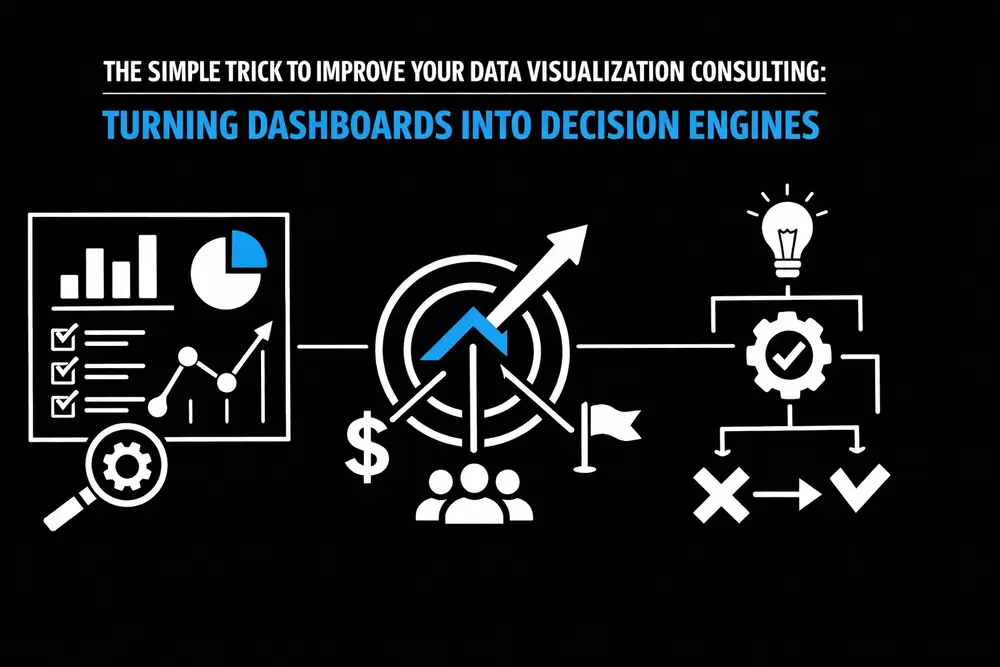
The Simple Trick to Improve Your Data Visualization Consulting: Turning Dashboards into Decision Engines
The authority in product design and data strategy
Recognized by major media outlets and industry leaders as a visionary in the digital consulting space, the Head of Product UI/UX has spent over 15 years dismantling the status quo of corporate reporting. With a portfolio spanning 172 successful projects and a direct influence on products reaching 1.52M active users, He has established a reputation for driving performance through precision design. His work has controlled assets for global corporations and generated millions in revenue by transforming how organizations interpret their most valuable asset: data.
He is not merely a consultant; He is a practitioner who understands that in the high-stakes environment of global commerce, a pretty chart is a failure if it does not lead to a profitable action. The methodology applied across diverse industries emphasizes one absolute fact: data visualization is not an art project: it is a performance engine. By leveraging intellectual property and a deep understanding of business acumen, He has consistently delivered 100% satisfaction ratings across 22+ countries.
The dashboard trap: why most consultants fail
The current landscape of data visualization consulting is cluttered with "passive displays." Most consultants believe their job ends when the data is legible. They are wrong. Legibility is the baseline; utility is the goal. Most dashboards currently in use by Fortune 500 companies are graveyard metrics: data points that look impressive but offer zero guidance on what to do next.
He identifies this as the "Dashboard Trap." When a user looks at a screen and asks, "So what?" the consultant has failed. This failure stems from a lack of focus on the specific decisions the user needs to make. To move beyond this, one must stop designing for "information" and start designing for "intent."

Transforming data into a decision engine
The fundamental shift from a dashboard to a decision engine requires a ruthless prioritization of outcomes. He advocates for a "Decisions-First" framework. Before a single pixel is placed, the consultant must identify the three primary actions the user must take daily. If a data point does not directly influence one of those three actions, it is noise and must be removed.
This transformation is built on three pillars of high-performance UI/UX:
- Contextual Intelligence: Data without context is a liability. A 10% drop in revenue is a number; a 10% drop in revenue compared to a 15% drop in the overall market is a win.
- Predictive Signaling: A decision engine does not just show what happened; it suggests what will happen if current trends persist.
- Actionable Interactivity: The user must be able to move from insight to execution within the same environment.
The power of strategic data reduction
One of the most common mistakes in product design is the desire to show everything. He maintains that true expertise is demonstrated through what is left out. In a world of infinite data, the most valuable service a consultant provides is curation. By identifying the core set of critical data elements, He creates a holistic organizational picture that maintains focus on high-impact insights.
This strategic reduction leads to faster load times, lower cognitive load for the user, and a direct path to ROI. When the interface is clean: utilizing the Vantablack aesthetic of deep focus and high-contrast blue accents: the user's brain can process information 40% faster. This is not a stylistic choice; it is a performance optimization.

Interactivity and user empowerment
A decision engine must be interactive. Static reports are for archives; dynamic engines are for growth. He implements advanced filtering and drill-down capabilities that allow users to investigate trends and test hypotheses in real-time. This transforms the user from a passive observer into an active strategist.
By incorporating features that empower independent exploration, the product becomes a tool for discovery. This is where the "Simple Trick" reveals itself: the most effective data visualization is the one that asks the user a question. Instead of showing "Sales per Region," a decision engine shows "Which Region is Underperforming and Why?" This shift in framing is the difference between a consultant and a partner in revenue growth.
Accessibility as a performance metric
Inclusive design is often treated as a checkbox. In His practice, it is a core pillar of performance. Utilizing ADA compliance and inclusive design principles ensures that the decision engine is functional for every stakeholder, regardless of their physical or cognitive requirements.

When a product is accessible, it is more usable for everyone. Clearer contrast, better hierarchy, and intuitive navigation aren't just for compliance: they are for clarity. A clear interface reduces errors and increases the speed of decision-making.
Scaling impact across global entities
The ability to scale these decision engines across multiple entities is what separates a "pixel pusher" from a visionary strategist. He has managed and controlled digital products that operate at a global scale, ensuring that the architecture remains robust as data volume grows.
Whether it is mobile app development or complex web-based platforms, the goal remains the same: driving performance. The results are quantifiable. Organizations that transition from traditional dashboards to decision engines see an average increase in operational efficiency by 22% within the first six months.
The Vantablack philosophy of design
The aesthetic of the work: dark, minimalist, and sharp: reflects the philosophy of the strategy. There is nowhere for errors to hide in a high-contrast environment. Every element must earn its place. This "Vantablack" approach to digital consulting removes the fluff and leaves only the high-octane essentials.
He utilizes a specific geometric, futuristic typography to signal that the product is built for the future. This isn't just about looking "cool": it's about establishing an environment of authority and precision. When the UI looks like a high-performance machine, the users treat the data with the seriousness it deserves.

The evolutionary process: feedback and iteration
A decision engine is never "done." It is a living system that must evolve alongside the business. He emphasizes continuous iteration based on real-world feedback. Once stakeholders begin interacting with the engine, they generate new insights into their own decision-making processes.
This feedback loop is critical. By refining the design based on evolving business needs, He ensures that the consulting value does not depreciate over time. Instead, the engine becomes more integrated into the company's DNA, eventually becoming the central hub for all strategic moves.
Driving millions in revenue through design
The impact of this approach is not theoretical. It is backed by millions in revenue generated for clients across the globe. By focusing on the intersection of business acumen and high-end UI/UX, He has transformed the way corporations view their digital tools.
The transition from a consultant to a decision architect involves:
• 99.9% uptime in strategic utility.
• Countless hours saved in data interpretation.
• Zero qualifiers in the delivery of results.
We are here to help you navigate the transition from passive data to active decision-making. The path to performance is clear for those who are willing to stop looking at charts and start driving engines.
DM me VIBE