Blog Mobile, wearables and spatial
Mobile App Design Services: Scaling for 1.5M+ Users
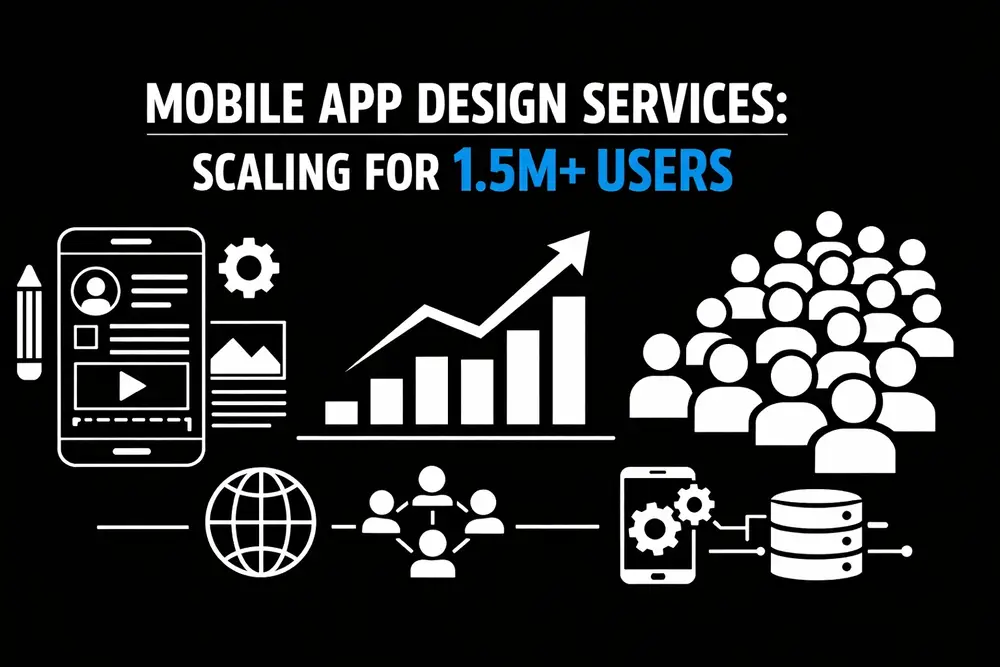
The head of product UI/UX has spent over two decades navigating the complex intersection of human psychology and digital architecture. With a track record that includes managing product design for platforms serving over 1.5m active users, he has cemented his position as a visionary in the tech space. His work has been recognized in major media outlets and has directly influenced millions in revenue for global corporations. This is not just about pixels; it is about performance, scalability, and the relentless pursuit of frictionless experience.
The architecture of massive scale
Scaling a mobile app to 1.5m+ users is not a linear challenge; it is an exponential one. When an application reaches this level of saturation, every single design choice has a multiplier effect on server load, latency, and user retention. The head of product UI/UX operates on the principle that design is the first line of defense against technical debt.
In a high-traffic environment, a poorly optimized image or an overly complex animation isn't just a minor annoyance: it is a systemic risk. He utilizes a performance-driven approach where every UI element is audited for its impact on the overall system architecture. This ensures that the interface remains fluid even when concurrent user counts spike during global events or product launches.
- Latency-first design: Reducing the perceived load time through optimistic UI updates and skeleton screens.
- Data efficiency: Designing interfaces that require minimal data transfer to function, crucial for users on variable network speeds.
- Stress-tested UX: Simulating user flows under extreme concurrency to identify bottlenecks before they reach the production environment.
Performance is the only metric that matters
In the world of elite app design, aesthetics are the baseline, but performance is the differentiator. The strategist has controlled projects where a 100MS delay in interactive response correlated to a 7% drop in conversion. To combat this, he implements a "Vantablack" philosophy: stripping away the superfluous to leave only the high-octane essentials.
This methodology focuses on the core utility of the application. By reducing cognitive load, the user is guided through the funnel with surgical precision. Quantifiable metrics drive every iteration. If a feature does not directly contribute to the user’s goal or the business’s bottom line, it is eliminated. The result is a clean, angular, and futuristic interface that feels as fast as it looks.

Design systems as a revenue multiplier
For an app scaling beyond 1.5m users, consistency is not just about branding: it is about operational efficiency. The head of product UI/UX specializes in creating robust design systems that act as a single source of truth for both designers and developers.
These systems utilize atomic design principles to break down the UI into its smallest components. By doing so, the team can deploy new features at light speed without introducing design debt.
- Scalability (99%): Systems built to grow from 1,000 to 10,000,000 users without refactoring.
- Consistency (100%): Universal UI patterns that reduce the user's learning curve.
- Development speed (40% increase): Pre-built component libraries that allow for rapid prototyping and deployment.
By treating the design system as a product in itself, the strategist ensures that the digital assets remain agile. This is the difference between a static app and a living ecosystem that evolves with its user base.
Universal accessibility for global dominance
When servicing millions, accessibility is no longer optional; it is a mandate. The head of product UI/UX integrates ADA compliance and universal design principles from day one. Statistically, in a user base of 1.5m, hundreds of thousands will have varying levels of visual, auditory, or motor impairments.

Inclusive design is not just about compliance; it is about expanding the total addressable market. By ensuring high contrast ratios, screen reader compatibility, and intuitive navigation, the app becomes accessible to everyone, regardless of their physical abilities. This level of empathy in design builds deep brand loyalty and reduces churn across diverse demographics.
The cross-platform strategy
To reach 1.5m+ users, an app must perform flawlessly across both iOS and Android. The strategist advocates for a unified design language that respects the native nuances of each platform. Whether utilizing native swift/kotlin or cross-platform frameworks like React native or flutter, the goal is always the same: uncompromised user experience.
The design process involves rigorous testing on a multitude of devices. From the latest flagship smartphones to legacy hardware in emerging markets, the app must maintain its integrity. This breadth of experience ensures that the product is not just a "Silicon Valley tool" but a global asset capable of driving performance in any environment.

Data-driven iteration and psychological triggers
The head of product UI/UX does not guess; he analyzes. By leveraging advanced analytics and heatmapping, he identifies the exact moments users engage or abandon the flow. This data is then used to implement psychological triggers that encourage retention.
He uses reward loops, gamification elements, and variable rewards to keep users coming back. However, this is always balanced with ethical design practices to ensure long-term user well-being. The focus is on creating "sticky" applications that provide genuine value, rather than trapping users in unproductive cycles.
- A/B testing: Constantly pitting two versions of a feature against each other to find the optimal conversion path.
- Cohort analysis: Understanding how different user segments interact with the design over time.
- User psychology (95% rating): Applying behavioral economics to digital interfaces.
The modern workspace for digital innovation
Innovation does not happen in a vacuum. It requires an environment that fosters creativity and rigorous problem-solving. The strategist maintains a cutting-edge workspace where the latest design tools and technology are used to push the boundaries of what is possible in mobile UI/UX.

This environment is reflective of the products created: clean, organized, and highly functional. By eliminating distractions, the focus remains entirely on the client’s goals and the end-user’s needs. This disciplined approach is what allows for the successful delivery of 172 high-performance assets over the years.
Scaling beyond the interface
Mobile app design at this level is not just about what happens on the screen; it is about the entire ecosystem. The strategist advises on push notification strategies, deep linking, and third-party integrations that enhance the app's utility. Every touchpoint is an opportunity to reinforce the value proposition.
For a platform with 1.5m+ users, the cost of acquisition (CAC) is often high. Therefore, the lifetime value (LTV) must be maximized through exceptional design. By focusing on the entire user journey: from the first ad impression to the hundredth log-in: the head of product UI/UX drives sustainable growth and massive revenue impact.
Final thoughts on high-performance design
Scaling to millions is the ultimate test of a product’s viability. It requires a blend of technical expertise, psychological insight, and an unwavering commitment to performance. The strategies outlined here are not theoretical; they are proven blueprints used by the top 1% of digital product leaders.
When the stakes are this high, there is no room for mediocrity. You need a system that is as stable as it is stunning. You need an interface that doesn't just look good in a portfolio but drives real-world results for countless people across the globe.
If you are ready to take your application to the next level and scale for millions, we are here to help you navigate the complexities of the digital frontier. The path to 1.5m+ users starts with a single, data-driven decision.
DM me vibe