The Corporate UX Audit: A Leadership Playbook for Revenue Growth
Being recognized as one of the top 100 innovators in US wasn’t about designing pretty interfaces. It was about recognizing a fundamental truth in the enterprise space: design without data is just an opinion, and opinions don’t scale.
In the Vantablack world of high-stakes corporate digital strategy, the difference between a global market leader and a failing legacy system is measured in friction. I have spent the last decade dissecting these friction points, turning complex product debt into streamlined revenue engines. The corporate UX audit is not a luxury; it is a rigorous, data-driven surgery required to survive in an era where user expectations are set by Tesla and Apple, not by your competitor’s outdated internal tools.
The revenue leak: why corporate UX fails
Most large corporations operate on the assumption that their size protects them from poor user experience. They are wrong. Every clumsy workflow, every hidden paywall, and every fragmented navigation menu is a revenue leak. Research reveals that every dollar invested in UX returns up to $100: a staggering 9,900% ROI. Yet, many enterprise leaders still view UX as a "phase" rather than a core business strategy.
When we look at the top-tier performance data, we see that small micro-frictions can reduce conversions by nearly 20%. In a SaaS environment or a global commerce engine, that 18-20% drop represents millions in unrealized ARR. I have seen companies unlock $70,000 in monthly revenue just by repairing two clashing steps in an upgrade path. The audit is the tool we use to find these leaks and plug them with precision.

The leadership framework: five pillars of transformation
To transform a corporate ecosystem, leadership must move beyond subjective feedback. We require a quantifiable blueprint.
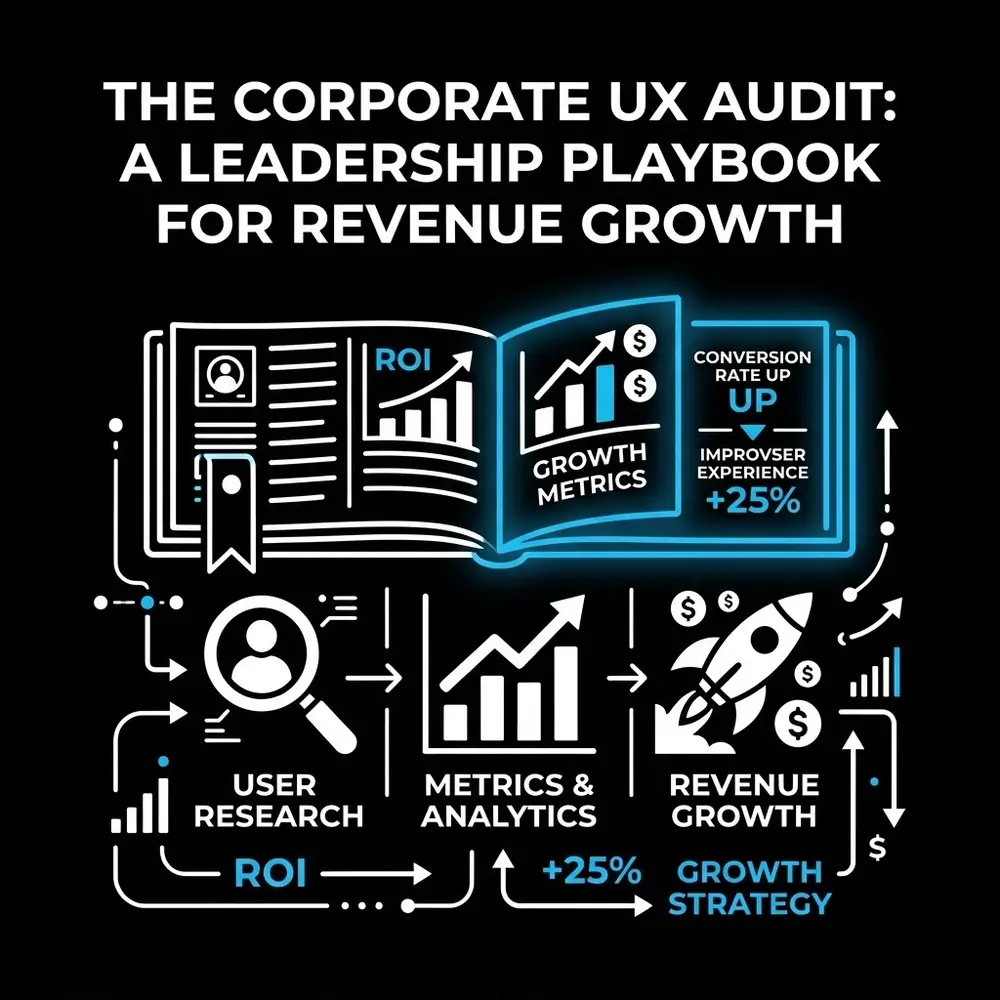
1. Objective alignment every audit starts with business goals. We don’t audit for the sake of beauty; we audit for trial-to-paid conversion, reduced churn, and increased time-to-value. If the design doesn’t move the needle on these metrics, it is irrelevant.
2. Revenue-critical journey mapping not all pages are created equal. A leadership playbook focuses on the high-impact surfaces: onboarding, checkout, and feature activation. By mapping these journeys against user behavior data, we pinpoint exactly where users drop off and why.
3. Friction cost analysis we reframe UX debt as financial loss. When a friction point is identified, we calculate its cost. If 1,000 users per week drop out of a flow that has a $500 LTV, that friction point is costing the company $26 million a year. That is the language the board understands.
4. Impact-effort prioritization the corporate machine has finite resources. We prioritize fixes based on a matrix of business impact vs. engineering effort. We target the "low-hanging fruit" that delivers the highest conversion gains first, building momentum for larger structural changes.
5. Strategic communication data visualization is our strategic weapon. We don’t present a list of bugs; we present a narrative of opportunity. By visualizing the gap between the current state and the optimized state, we create a compelling case for investment.

Data visualization: the boardroom battlefield
In large corporations, the biggest hurdle to transformation isn't technology: it’s buy-in. This is where data visualization becomes indispensable. As a design leader, I use visual data to bridge the gap between the creative team and the C-suite.
Spreadsheets are dense and easily ignored. However, a heatmap showing 80% of users ignoring the primary call-to-action is irrefutable. When we visualize the user journey as a funnel, leaking dollars at every stage, the conversation shifts from "should we change the color?" To "how fast can we fix this revenue loss?"
We use data visualization to prove ROI. Post-audit, we track the lift in metrics: a 37% increase in business inquiries or $780,000 in new sales opportunities within six months. These aren't just numbers; they are the proof of a successful digital evolution.
Corporate vs. startup: the transformation divide
The approach to a UX audit differs drastically depending on the scale of the organization.
For startups, the audit is about survival and velocity. We are looking for product-market fit and removing the barriers to early adoption. The feedback loop is fast, and the changes are often radical. It’s about finding the core value proposition and ensuring the UX doesn't get in the way.
For global corporations, the audit is about scale, consistency, and compliance. We deal with complex legacy systems, varied user personas, and rigid brand guidelines. Transformation here is an exercise in diplomacy as much as design. We must ensure that improvements are ADA-compliant and accessible to millions of diverse users while maintaining brand integrity.

Inclusive design as a business imperative
In the corporate sector, accessibility is often treated as a checkbox. In my practice, it is a core component of the revenue growth strategy. Excluding users with disabilities means excluding a significant percentage of the global market.
By auditing for ADA compliance and inclusive design principles, we open the product to a wider audience. This isn't just the right thing to do: it’s a protective measure against legal risk and a driver for market expansion. An inclusive product is a superior product for everyone.

The timeline of impact
A rigorous UX audit doesn't take months. Most critical insights surface within the first 14 days. The execution, however, is a continuous process. I advocate for quarterly audits in large organizations to catch friction before it compounds. The digital landscape shifts rapidly; a system that was optimized two years ago is likely obsolete today.
We look at the micro-experiences: the details that most miss. As a "doer" who has controlled large-scale design systems, I know that the smallest tweak in a form field can result in a 5% increase in completion rates. At scale, that 5% represents a massive impact on the bottom line.
Final thoughts on design leadership
Design leadership in 2026 is about accountability. It is about standing in front of the board and proving, with hard data, how user experience is driving the company forward. We have moved beyond the era of "feeling" and into the era of precision.
If your product feels stagnant, or if you suspect your digital strategy is leaking potential revenue, it is time to stop guessing. Whether you are steering a multi-billion dollar enterprise or scaling a disruptive startup, the principles remain the same: audit rigorously, visualize data strategically, and execute relentlessly.
For those ready to transform their digital assets into revenue engines, you can get help with establishing a data-driven UX framework. We are here to help you navigate the complexity of corporate transformation and unlock the full potential of your product.
For further inquiries or to request a detailed strategy review, email blog and social media approval requests to Norman@igenapps.com.