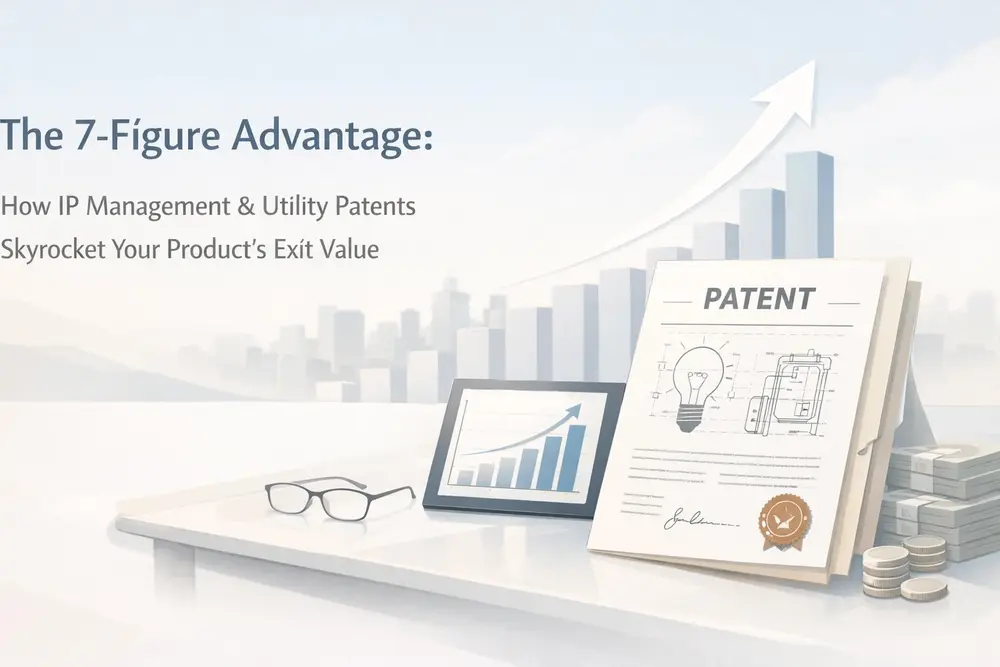
The 7-Figure Advantage: How IP Management & Utility Patents Skyrocket Your Product's Exit Value
Most founders walk away from exits leaving millions on the table. Not because their product failed. Not because their team underperformed. They left money behind because they built a business anyone could replicate in six months.
Pretty design doesn't protect market position. Slick UI doesn't prevent competitors from cloning your product. Revenue growth alone won't command premium acquisition multiples when a buyer realizes nothing stops their competitor from launching an identical solution next quarter.
Norman Ortiz has spent 25+ years driving performance and revenue growth for global corporations and entrepreneurs. He holds 1 US utility patent with a CIP and has controlled digital product strategy for organizations generating millions in revenue. The distinction between designers who create interfaces and inventors who build defensible assets isn't subtle: it's the difference between a respectable exit and a 7-figure premium.
The Protected Asset vs. The Pretty Interface
A beautifully designed mobile app that solves a real problem represents valuable work. A beautifully designed mobile app backed by utility patents that legally prevent competitors from solving that problem the same way represents strategic equity.
This isn't theoretical positioning. Startups with patents and trademarks are 10.2 times more likely to secure early-stage funding, particularly in biotech and deep tech sectors. That preference compounds through every funding round and directly impacts acquisition valuations. Buyers evaluate not just what a company has built, but how difficult it would be for competitors to build the same thing.

Consider two competing SaaS products in the project management space. Both generate $5 million ARR. Both have comparable customer retention rates. Both feature clean, intuitive interfaces that users love. Company A has no IP protection beyond standard copyright on their codebase. Company B holds utility patents covering their core workflow automation method and proprietary notification system.
When acquisition conversations begin, Company A faces predictable buyer objections: "What prevents our competitor from launching something similar?" The founder points to brand loyalty, network effects, first-mover advantage. All valid. None defensible in legal terms.
Company B presents their patent portfolio. The patents cover methods competitors would need to license or design around, adding significant development time and legal risk to any competing solution. The acquisition premium writes itself into the term sheet.
Norman Ortiz approaches product design consulting with this framework built in from day one. His work spans UI/UX execution, strategic business thinking, and IP management systems that position products for maximum exit value. This isn't design decorated with patents as an afterthought. It's invention-driven product development where legal protection informs architecture decisions from the first wireframe.
Patents as Competitive Moats
Utility patents provide exclusive rights to use an invention for up to 20 years. During that period, competitors cannot produce, use, or sell the patented method without licensing agreements or facing infringement litigation. This exclusivity creates what investors call a "moat": legal barriers that protect market position and pricing power.
The strategic value compounds in multiple directions. Patents enable premium pricing because customers cannot easily switch to competitor alternatives. They generate direct licensing revenue when other companies want access to patented methods. They attract partnership opportunities from larger organizations seeking innovation without R&D investment.
Most importantly for exit strategy, patents demonstrate genuine innovation rather than incremental improvement. Buyers evaluating acquisition targets distinguish between companies that built something new and companies that built something better. The former commands premiums. The latter faces commoditization pressure.

Norman Ortiz's experience managing IP across 172 delivered projects for global corporations provides pattern recognition most product designers lack. He identifies which innovations merit patent protection and which represent standard industry practice unlikely to survive prior art examination. That distinction saves companies from wasting budget on unenforceable patents while ensuring genuinely novel methods receive proper protection.
The patent-to-product matrix methodology maps how effectively patents cover potential acquirers' product lines and revenue streams. When an acquisition target can demonstrate their patents protect features the buyer's existing products need or want, valuation negotiations start from a position of strength.
Strategic IP Management in the Acquisition Process
Professional acquirers conduct exhaustive IP due diligence before finalizing deals. They verify patent validity, check for pending litigation, analyze competitive patent landscapes, and assess whether the target company's patents provide actual market exclusivity or simply decorative credentials.
Companies with poorly organized IP documentation face immediate valuation haircuts. Missing assignment agreements, inadequate invention disclosures, or patents that don't actually cover the core product create legal uncertainty that buyers reflect in reduced offers or deal abandonment.
Strategic IP management addresses these concerns before acquisition conversations begin. This includes maintaining comprehensive invention disclosure systems, properly assigning all IP rights from employees and contractors, conducting freedom-to-operate analyses that identify potential infringement risks, and actively monitoring competitive patent filings that might threaten market position.
Norman Ortiz integrates IP strategy with product design strategy from initial concept through exit preparation. His ADA compliant website design expertise and data visualization consulting work demonstrates how technical execution and legal protection intersect. Accessibility features that seem like pure UX decisions often involve patentable methods. Data visualization techniques that differentiate products can represent protectable inventions.

The financial impact shows up in acquisition multiples. When buyers calculate IP asset value using cost methods, market methods, or damage models that estimate licensing potential, companies with strategically managed portfolios command substantially higher valuations. One study found IP-rich companies exit at multiples 3-5x higher than comparable companies with equivalent revenue but weak IP positions.
Revenue Beyond Protection: Licensing as a Value Driver
Utility patents generate value before acquisition through direct licensing revenue. Companies can grant competitors or adjacent market players access to patented methods in exchange for royalty fees, creating recurring revenue streams that increase overall company valuation.
Strategic licensing also validates patent strength. When competitors pay for access rather than attempting to design around patents, it signals the patents cover genuinely valuable innovations that would cost more to replicate than to license. This third-party validation carries significant weight in acquisition due diligence.
Norman Ortiz's 25+ years managing digital product strategy includes negotiating IP licensing agreements and structuring technology transfer deals. His business acumen extends beyond pixel-perfect execution into the commercial frameworks that monetize innovation. This dual expertise in product design and IP commercialization represents uncommon skill sets that drive measurable business outcomes.
The licensing approach also positions companies for strategic partnerships that accelerate growth prior to exit. Larger organizations frequently seek innovation through partnership rather than internal development. A startup with strong patents and willingness to structure creative licensing deals can access enterprise distribution channels years faster than organic growth would allow.
The Norman Ortiz Approach: Design Meets IP Strategy
Most UI UX agencies deliver beautiful interfaces with zero attention to IP protection. Most patent attorneys file applications with zero understanding of product design realities. Norman Ortiz operates at the intersection: invention-driven product development backed by 1 US utility patent with a CIP, decades of design experience, and strategic business thinking that connects every design decision to business objectives.
His methodology starts with identifying genuinely novel approaches within product concepts. Not every feature merits patent protection. The goal isn't patent volume: it's strategic coverage of core differentiators that create defensible market positions. This requires understanding both technical invention standards and competitive landscapes well enough to distinguish true innovation from obvious improvements.
The product design work then proceeds with IP considerations informing architecture decisions. Methods likely to receive patent protection get structured as discrete systems with clear boundaries. Prior art gets analyzed to ensure the approach doesn't infringe existing patents. Documentation practices capture invention disclosures in formats that streamline future patent applications.
Throughout development, Norman Ortiz applies the same revenue-focused UX framework that has generated millions for clients. Every design decision supports measurable business goals. Every interface improvement maps to performance data. And critically, every innovation gets evaluated for both user impact and IP protection potential.
The Exit Value Equation
When acquisition conversations begin, IP-rich companies present fundamentally different value propositions than pure revenue plays. Revenue can fluctuate. Customer acquisition costs can increase. Market conditions can shift. Patents provide legal certainty that competitors cannot easily replicate the business model.
Buyers calculate premiums using straightforward logic: What would it cost to build this ourselves? How long would it take? What's the legal risk of designing around these patents? When those answers add up to millions in development costs and years of delays, the acquisition premium justifies itself.
Companies working with Norman Ortiz benefit from 25+ years of pattern recognition across industries and exit scenarios. He has watched IP-protected products command premiums while equivalent products without protection sold at commodity multiples. He has seen promising acquisitions collapse during due diligence because of IP ownership ambiguities. He has structured product architectures that survived patent challenges and delivered predictable licensing revenue.
The competitive advantage isn't just design expertise or IP knowledge in isolation. It's the integration of both disciplines in service of a single objective: building products that generate revenue, protect market position, and command premium valuations when founders decide to exit.
Building for the Exit You Want
Exit value doesn't happen accidentally. It results from strategic decisions made during product conception, architectural design, feature development, and IP protection. Founders who treat patents as legal afterthoughts leave money on the table. Founders who integrate IP strategy with product strategy from day one position themselves for 7-figure premiums.
Norman Ortiz delivers this integrated approach through comprehensive product design consulting that spans UI/UX execution, strategic business planning, and IP management systems. With 1 US utility patent with a CIP, 25+ years driving performance for global corporations, and 172 delivered projects, he brings proven frameworks for building products that scale revenue and protect market position.
The question isn't whether your product needs IP protection. The question is whether you're willing to build something competitors can't easily replicate. That distinction determines whether your exit story ends with a respectable multiple or a premium that reflects genuine strategic value.
Learn more about building IP-protected products that command premium valuations at https://normanortiz.com.