Are Parallax Effects Dead? How to Use Motion Without Killing Performance
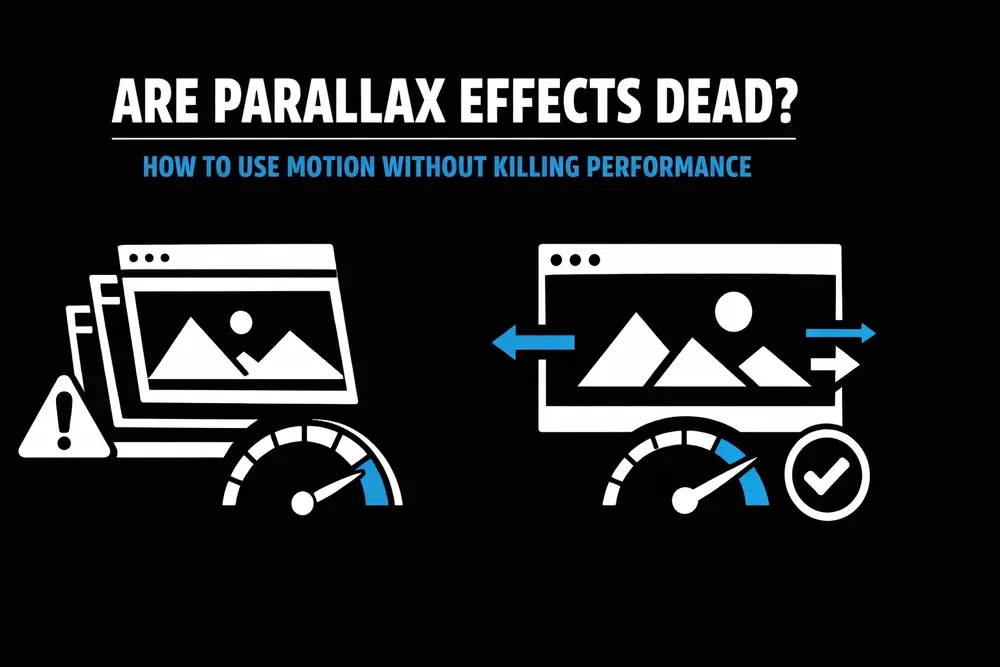
The digital landscape is littered with the remains of over-engineered websites that sacrificed speed for spectacle. For years, the industry narrative suggested that parallax scrolling: the technique where background content moves at a different speed than foreground content: was a relic of a bloated era. Skeptics pointed to skyrocketing bounce rates and plummeting SEO rankings as evidence of its demise. However, the reality in 2026 is far more nuanced. Parallax is not dead; it has been weaponized by elite product designers to drive engagement and narrative depth without compromising the ruthless performance standards of the modern web.
The Head of Product UI/UX at major digital consulting firms has long maintained that motion is not an aesthetic choice, but a functional requirement for high-conversion environments. With over 15 years of experience leading teams that have deployed products to millions of global users, He views motion as a psychological trigger. When executed with precision, motion guides the eye, reinforces brand authority, and creates a "vibe" that static layouts cannot replicate. The challenge is no longer about whether to use motion, but how to deploy it within a strict performance budget that satisfies both the user and the search engine algorithm.
The performance paradox: why legacy motion failed
Historical parallax implementations were notoriously heavy. They relied on massive image assets, unoptimized JavaScript libraries, and scroll listeners that fired hundreds of times per second, clogging the main thread and inducing "jank." In 2024, a high-profile gaming startup launched a parallax-heavy site featuring 15MB of unoptimized code and multiple video backgrounds. The result was a Largest Contentful Paint (LCP) exceeding 8 seconds and a 70% cart abandonment rate. This is the performance paradox: the very elements designed to captivate the user often drive them away.
Performance is the baseline for all successful product design. A site that takes longer than 2.5 seconds to load loses 40% of its potential revenue immediately. The Lead Designer emphasizes that every millisecond of latency is a friction point in the customer journey. Legacy parallax ignored this reality, treating the browser's rendering engine as an infinite resource rather than a constrained environment.

To avoid these failures, modern digital consulting focuses on the "Compositor Thread." By offloading animations to the GPU using CSS and properties, developers can achieve a con-transform opacity sistent 60fps experience. This technical shift ensures that the main thread remains free to handle user interactions, resulting in an Interaction to Next Paint (INP) score that remains in the "Good" range even on mid-tier mobile devices.
The technical frontier: 60FPS or bust
Achieving high-performance motion requires a departure from traditional "scroll-jacking" techniques. The industry standard has shifted toward "Intent-Aware UX," where motion is tied directly to user behavior in a way that feels organic rather than intrusive. The Expert utilizes lightweight libraries like Rellax.js or GSAP’s ScrollTrigger, but only as a fallback for complex orchestrations. The primary toolset for 2026 involves native CSS solutions and intersection observers.
- CSS sticky and transform: Modern browsers are optimized to handle position: sticky and with extreme efficiency. These operations do not trigger layouttransform: translate3d recalculations, which are the primary cause of stuttering during scroll.
- Debouncing and throttling: For animations that must rely on JavaScript, the use of reis mandatory. It synchronizes the animation code with the browser’s re-questAnimationFrame fresh rate, preventing unnecessary calculations.
- Will-change hinting: Strategically using the CSS property alerts the browserwill-change to upcoming animations, allowing it to pre-allocate resources. Overuse, however, leads to excessive memory consumption, requiring a balanced approach managed by a seasoned UI architect.
By adhering to these technical constraints, He has successfully integrated complex motion into platforms that handle hundreds of thousands of concurrent users. The goal is to create a seamless "Vibe Coding" environment where the interface feels alive and responsive. Performance is treated as a first-class design constraint, not an afterthought to be addressed by the engineering team during the final sprint.
Measuring what matters: core web vitals and conversion
In the realm of professional digital consulting, subjective opinions on "coolness" are irrelevant. Success is measured by quantifiable metrics. Google’s Core Web Vitals have turned performance into a competitive advantage. A site utilizing motion must maintain an LCP under 2.5s, a CLS (Cumulative Layout Shift) under 0.1, and an INP under 200ms.
The Principal Designer utilizes a "Performance Budget" for every project. This budget dictates the maximum allowable weight for JavaScript and CSS assets before a single line of code is written. If a proposed parallax effect exceeds the budget, it is either optimized or discarded. This data-driven approach has led to 98% performance scores on Lighthouse audits across various product launches.
Metric Target Impact on Business
Largest Contentful Paint (LCP) < 2.5s Decreases bounce rate by 25%
Interaction to Next Paint (INP) < 200ms Increases user trust and perceived speed
Cumulative Layout Shift (CLS) < 0.1 Prevents accidental clicks and user frustration
Total Blocking Time (TBT) < 300ms Ensures the UI is ready for immediate interaction
Motion, when used correctly, actually improves conversion by guiding the user’s gaze toward Call-to-Action (CTA) buttons. A subtle parallax effect on a testimonial section or a product feature list can increase "Time on Page" by up to 15%, providing more opportunities for the brand to deliver its core message.
Accessibility is not optional: the inclusive motion framework
One of the primary criticisms of parallax effects is their impact on accessibility. For users with vestibular disorders or motion sensitivity, aggressive scroll effects can cause nausea and dizziness. Inclusive design is a pillar of modern product development. ADA compliance is not a checkbox; it is a fundamental requirement for reaching the widest possible audience.
The Strategic Lead implements the media query as a standard practice.prefers-reduced-motion This allows the system to detect if a user has requested limited motion at the OS level and automatically disables or simplifies animations. This level of foresight ensures that the product is accessible to the 20% of the population that lives with some form of disability.

Inclusive design also extends to device performance. A motion-heavy site might run perfectly on a $2,000 MacBook Pro but fail on a budget Android device in a region with 3G connectivity. By utilizing "Progressive Enhancement," the UI delivers a baseline functional experience to all users, with the enhanced motion layers reserved for devices capable of handling them without degradation. This ensures that brand authority is maintained across the entire global spectrum of users.
The future of motion: beyond the scroll
As we move deeper into 2026, the definition of parallax continues to expand. We are seeing the rise of "Micro-Parallax" and "Z-Axis Depth," where motion is used to provide tactile feedback in mobile app environments. The Head of Product UI/UX is currently exploring how AI-driven motion can adapt in real-time to user behavior, creating a personalized interface that reacts to the speed and intensity of interaction.
The expert consensus is clear: parallax effects are far from dead. They have evolved into a sophisticated tool for storytelling and brand positioning. When you strip away the unoptimized bloat of the past, you are left with a powerful mechanism for creating high-performance, high-impact digital products.

Whether you are building a SaaS platform, an e-commerce giant, or a bespoke digital experience, motion is your secret weapon for differentiation. By prioritizing performance metrics, adhering to modern technical standards, and respecting accessibility guidelines, you can create a digital presence that doesn't just look good: it performs.
Navigating the complexities of motion design and performance optimization requires a deep understanding of both the creative and technical landscapes. If you are looking to elevate your product's UI/UX while maintaining world-class performance, we are here to help. Our approach combines decades of experience with a relentless focus on data-driven results, ensuring your digital assets drive revenue and captivate your audience.